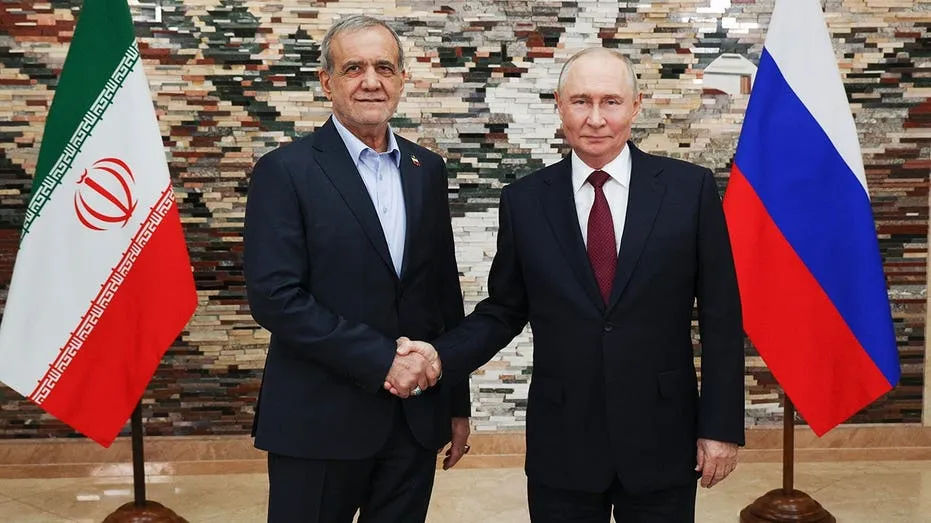
Russia Secures $16.5B Nuclear Deal on Kazakhstan’s Doorstep in Major Pact, Reports Say Hot News

Russia Secures $16.5B Nuclear Deal on Kazakhstan’s Doorstep in Major Pact, Reports Say

(SeaPRwire) - Per multiple reports, Russia inked a landmark nuclear agreement with Kazakhstan on Thursday to construct the Central Asian country’s first ever commercial nuclear power plant, representing a major geopolitical and economic win for President Vladimir Putin. As reported by Reuters, the $16.5 billion project, formalized during high-level bilateral discussions in Astana between Putin and Kazakh President Kassym-Jomart Tokayev, will be supported by a Russian export loan that covers roughly 85% of the total cost. Rosatom, Russia’s state-owned nuclear corporation, will oversee construction work near the village of Ulken in southeastern Kazakhstan, along the shores of Lake Balkhash. The outlet noted that Rosatom secured the main construction contract after outcompeting bids from China National Nuclear Corp., France’s EDF and Korea Hydro & Nuclear Power. The pact directly furthers the Kremlin’s efforts to solidify its economic and geopolitical clout across former Soviet states amid ongoing Western sanctions. Data from the World Nuclear Association shows that Kazakhstan is the largest uranium producer across the globe. For Kazakhstan, the facility is designed to stabilize long-term domestic energy supplies, as the country has grappled with aging coal-dependent power infrastructure and electricity shortages for more than two decades. "The agreement signed today on the construction of the Balkhash NPP has an important role," Tokayev stated during the signing ceremony. Putin described the deal as "a flagship project in the field of peaceful nuclear energy" and noted that "the commissioning of the plant will make a significant contribution to the energy supply of the Kazakh economy, helping to provide businesses and households with affordable and clean energy." "I would like to point out that, as we agreed with the president of Kazakhstan, we are not simply talking about the creation of a nuclear power plant or construction; we are talking about the creation of an entire industry, including education, personnel training, and so on," he further added. Per Kazakhstan’s atomic energy agency, the large-scale facility will be equipped with two advanced VVER-1200 Generation III+ reactors. Total development costs are projected at $16.5 billion, with officials noting that approximately $2 billion of the total sum will be earmarked for security systems and foundational infrastructure. Construction work is scheduled to start in 2027, and the first reactor is slated to enter operation by early 2034. The project comes after a 2024 national referendum where Kazakh voters formally approved development work at the Balkhash site. However, the shift to atomic energy is a sensitive issue for local residents. The country hosted hundreds of Soviet nuclear weapons tests at the Semipalatinsk site between 1949 and 1989, which left behind severe public health crises and environmental contamination. Public distrust grew further following the 1986 Chernobyl disaster in Ukraine, after which tens of thousands of Kazakh workers fell ill while assisting with cleanup operations. Per Bloomberg, the two countries also signed a currency swap arrangement on Thursday. Bank of Russia Governor Elvira Nabiullina and National Bank of Kazakhstan Governor Timur Suleimenov signed the ruble-tenge swap agreement. This article is provided by a third-party content provider. SeaPRwire (https://www.seaprwire.com/) makes no warranties or representations regarding its content. Category: Top News, Daily News SeaPRwire provides global press release distribution services for companies and organizations, covering more than 6,500 media outlets, 86,000 editors and journalists, and over 3.5 million end-user desktop and mobile apps. SeaPRwire supports multilingual press release distribution in English, Japanese, German, Korean, French, Russian, Indonesian, Malay, Vietnamese, Chinese, and more.
More
Israel Rejects UN Accusation, Tightens Diplomatic Separation Hot News

Israel Rejects UN Accusation, Tightens Diplomatic Separation

(SeaPRwire) - Israeli officials have strongly condemned the United Nations, accusing the global body of adding Israeli entities to a sexual violence blacklist that also counts the terrorist group Hamas among its entries. "We are done engaging with this UN Secretary-General. Guterres has placed Israel on the same blacklist alongside Hamas, ISIS and the most depraved terrorist organizations across the world. This is a moral disgrace that proves Guterres has lost all credibility entirely," Israel's ambassador to the U.N. Danny Danon said in a statement shared with Digital. A spokesperson for Danon confirmed Israel is officially freezing relations with the secretary-general's office for as long as Antonio Guterres holds the position. Danon asserted Guterres made the choice to include Israeli entities on a blacklist covering sexual violence in conflict zones, a decision that prompted the freeze of relations with the U.N. Secretary-General's Office. "We are a robust democracy. We invited United Nations representatives to travel to Israel to investigate these ridiculous allegations. They chose not to come. They opted to continue their campaign targeting Israel. We already saw lies published in The New York Times, and now we see another lie coming from the U.N.," Danon said in a video shared with Digital. "We are done with this Secretary-General," he concluded. The United Nations has not confirmed that Israel was added to the sexual violence blacklist. The U.N. also did not respond to an inquiry from Digital. Digital also contacted The New York Times to request comment on the matter. The Jerusalem Post was first to report Wednesday night that the Israeli Prison Service will be included on the U.N.'s list of actors that commit sexual violence in conflict zones. In early May, The New York Times published an opinion piece by writer Nicholas Kristof that accused Israeli prison guards of carrying out institutionalized sexual abuse against Palestinian prisoners. Kristof cited a 2025 U.N. report that labeled the alleged Israeli sexual abuse of Palestinians "standard operating procedures towards Palestinians." Israeli officials firmly rejected the core claims of the piece, and accused Kristof and the Times of blood libel, threatening to sue the outlet in American courts. "In an unfathomable inversion of reality, and through an endless stream of baseless lies, propagandist Nicholas Kristof turns the victim into the accused. Israel -— whose citizens were the victims of the most horrific sexual crimes committed by Hamas on October 7, and whose hostages were later subjected to further sexual abuse -— is portrayed as the guilty party," the Israel Foreign Ministry wrote in a post on X in response to the Times piece. The Israeli Foreign Ministry released further comment Thursday on the reported U.N. blacklisting. "Over the past year, Israel's Ambassador to the UN and the Israeli delegation held a series of meetings with U.N. representatives and provided documents, data, as well as a detailed response to all the allegations that were raised. Despite this, the U.N. Secretary-General chose to advance a political decision and include Israel alongside Hamas and terrorist organizations," the foreign ministry wrote in a statement shared with Digital. "The shameful and absurd U.N. decision to include Israeli entities in the annex to the CRSV report is further proof of the UN’s true nature: a politicized and corrupt organization that has abandoned its founding principles and systematically targets Israel as its primary mission. This decision is yet another example of the UN’s long-standing, institutionalized hostility toward Israel. Today’s decision must be understood in its true context: an attempt to create a fake symmetry between Israel and the real sexual atrocities committed by Hamas. This is its sole motivation. The person behind this farce is Antonio Guterres," the statement continued. "This is the same Guterres who sought to 'contextualize' the October 7 massacre, who covered up the involvement of UN employees in those atrocities, and who has dragged the UN to its lowest point. Guterres is now exploiting his final months as Secretary-General to fabricate baseless accusations against Israel, completely devoid of any factual merit. Israel has comprehensively, thoroughly, and unequivocally refuted these allegations. Given that António Guterres has chosen to violate every standard of honesty, integrity, and professionalism, Israel has decided to sever all ties with the Secretary-General’s Office and will wait until a new UN Secretary-General is appointed," the statement concluded. This article is provided by a third-party content provider. SeaPRwire (https://www.seaprwire.com/) makes no warranties or representations regarding its content. Category: Top News, Daily News SeaPRwire provides global press release distribution services for companies and organizations, covering more than 6,500 media outlets, 86,000 editors and journalists, and over 3.5 million end-user desktop and mobile apps. SeaPRwire supports multilingual press release distribution in English, Japanese, German, Korean, French, Russian, Indonesian, Malay, Vietnamese, Chinese, and more.
More

Three Injured in Swiss Train Station Attack Using a Bladed Weapon, Allegedly Shouting ‘Allahu Akbar’

(SeaPRwire) - Zurich Cantonal Police have reported the arrest of a man suspected of attacking three individuals at a train station in Switzerland on Thursday morning.One witness reportedly told the outlet Blick, "About 30 meters away, I heard a man behind me shout 'Allahu akbar' five or six times, very emotionally and agitatedly."According to Zurich Cantonal Police, "Shortly after 8:30 a.m., a man injured three people with a bladed weapon at Winterthur train station. The suspected perpetrator was arrested by police. He is a 31-year-old Swiss national." The release stated that the three wounded Swiss nationals, aged 28, 43, and 52, were taken to the hospital.The Associated Press reported that the incident occurred just before 8:30 a.m. Regional police chief Marius Weyermann stated that the suspect, who was apprehended five minutes after emergency services were alerted, is a 31-year-old Swiss-Turkish dual national residing in Winterthur.Weyermann also noted, as reported by the AP, that the man had previously come to the attention of authorities in 2015 for distributing Islamic State propaganda. More recently, he was sent to a psychiatric facility after making "confused comments" when calling the police emergency number, but he was released on Wednesday after a doctor determined he was not dangerous.Wyermann indicated, according to the AP, that two of the victims had been discharged or were about to be released from hospitals by mid-afternoon, while the 52-year-old remained hospitalized for surgery on a thigh injury.Zurich region's top security official, Mario Fehr, described the event as "an evil act of terror," the AP reported. The official also mentioned that the suspect was born in Switzerland, became a citizen in 2009, and had apparently spent a significant portion of the last two years in Turkey.The Associated Press contributed to this report This article is provided by a third-party content provider. SeaPRwire (https://www.seaprwire.com/) makes no warranties or representations regarding its content. Category: Top News, Daily News SeaPRwire provides global press release distribution services for companies and organizations, covering more than 6,500 media outlets, 86,000 editors and journalists, and over 3.5 million end-user desktop and mobile apps. SeaPRwire supports multilingual press release distribution in English, Japanese, German, Korean, French, Russian, Indonesian, Malay, Vietnamese, Chinese, and more.
More

US ally vows to aid Trump’s efforts to counter Iran’s Hormuz dominance: “Prepared to contribute”

(SeaPRwire) - UNITED NATIONS — Czech Foreign Minister Petr Macinka stated in an exclusive interview with Digital at the United Nations in New York that the Czech Republic stands ready to assist in safeguarding navigation freedom in the Strait of Hormuz. He noted that Prague is closely coordinating with the Trump administration regarding security matters, NATO, and Israel.Speaking during meetings related to the Security Council at the U.N., Macinka revealed that Prague has initiated talks regarding the contribution of specialized assets to help secure this strategically crucial waterway, particularly as tensions with Iran continue to rise."We are ready to contribute to freedom of passage and the Hormuz trade," Macinka affirmed."We were among the first countries that were ready to contribute … We have no navy, as we are in the middle of Europe," he elaborated, adding, "But we have some unique passive surveillance capabilities."Macinka cautioned that Iran represents a worldwide danger via four primary "war tools" he identified: nuclear proliferation, ballistic missiles and drones, international terrorism, and dangers to the Strait of Hormuz."Their nuclear military program must be stopped," he declared. "It’s a global risk and global threat."These remarks arrive as the Trump administration ramps up pressure on European partners to assume a greater role in defending international shipping lanes. This follows Iranian threats concerning the Strait of Hormuz, a pivotal choke point for global oil transit where approximately one-fifth of the world's oil consumption flows through the narrow channel linking the Persian Gulf to the Arabian Sea.Following a Friday gathering with foreign ministers in Sweden, Secretary of State Marco Rubio cast doubt on the utility of hosting U.S. military bases in allied nations that subsequently limit American military operations during times of war."One of the arguments I always made was that these bases in the region provided us with logistical options that we wouldn’t otherwise have," Rubio mentioned to the press. "And when some of those bases are denied to you during a conflict that we’re involved in, then you question whether that value is still there."President Donald Trump has also heavily criticized NATO allies for their hesitation to engage in military operations related to the Iran conflict and the security of the Strait of Hormuz.According to an April 1 interview with Britain’s Daily Telegraph, Trump stated he was "strongly considering" withdrawing the United States from NATO after allies declined to join the U.S. campaign against Iran, labeling the alliance a "paper tiger."Having been a NATO member since 1999, the Czech Republic has met the alliance’s 2% of GDP defense spending target and has backed appeals for Europe to boost military readiness in light of Russia's war in Ukraine.Macinka firmly supported the administration’s urging for Europe to hike defense spending and lessen its reliance on Washington for enduring security assurances."We should do our homework and build our defense to become stronger," he stated, arguing that Europe has postponed essential military investments for an excessive period.He also connected Europe’s defense spending difficulties to the European Union’s Green Deal policies—the bloc's extensive climate strategy designed to cut carbon emissions—denouncing them as ideological and financially ruinous."If we get rid of this green, crazy alarmism, then we have enough money to build our defense," he remarked.The Czech diplomat also offered notably direct backing for Trump and his administration, lauding what he characterized as a worldwide shift toward "common sense" subsequent to Trump’s electoral win."We are friends of Israel, and we are friends of America," Macinka expressed. "Especially me as a politician, I'm a friend of the ideology of the current American administration."Macinka also alluded to a confrontation earlier in 2026 with former Secretary of State Hillary Clinton at the Munich Security Conference, during which he critiqued Europe’s liberal political order and championed the populist trend transforming regions of Europe and the U.S.Macinka connected Prague’s robust backing of Ukraine to the Soviet-led invasion of Czechoslovakia in 1968, an event in which hundreds of thousands of Warsaw Pact soldiers occupied the nation for over two decades.He noted that this historical experience continues to mold Czech public sentiment and support for Kyiv."The Czech society feels a big solidarity with Ukraine," Macinka observed, describing the conflict as a "symmetric war" pitting a potent Russian military against a Ukrainian force supported by the West.Macinka emphasized Prague’s leadership in a Czech-backed ammunition project that is supplying Ukraine with artillery shells gathered via international donor contributions.Recalling a trip to Kyiv earlier in 2026, he mentioned receiving intelligence briefings regarding battlefield ammunition usage from Ukrainian military authorities.The Czech effort supplied over half a million rounds of ammunition in 2026 alone, according to Macinka, aiding in the stabilization of the battlefield prior to potential peace talks.Macinka contended that keeping a stable front line is crucial for substantive negotiations, cautioning that fluctuating battle lines would only serve to harden the demands of both parties.As Washington’s attention shifts increasingly toward the Middle East, Macinka asserted that Europe must start assuming a more significant diplomatic role in upcoming negotiations concerning Ukraine."America is quite busy with the Middle East," he stated. "Europe should wake up and ask for a place at the table." This article is provided by a third-party content provider. SeaPRwire (https://www.seaprwire.com/) makes no warranties or representations regarding its content. Category: Top News, Daily News SeaPRwire provides global press release distribution services for companies and organizations, covering more than 6,500 media outlets, 86,000 editors and journalists, and over 3.5 million end-user desktop and mobile apps. SeaPRwire supports multilingual press release distribution in English, Japanese, German, Korean, French, Russian, Indonesian, Malay, Vietnamese, Chinese, and more.
More
Belgium Train-Minisub Collision Results in Four Deaths and Child Injuries Hot News

Belgium Train-Minisub Collision Results in Four Deaths and Child Injuries

(SeaPRwire) - A high-speed passenger train collided with a minibus carrying children in Belgium on Tuesday, destroying the vehicle and resulting in four fatalities—including two children—while leaving five other children in critical condition.The severe crash occurred during the morning commute near Buggenhout, located approximately 20 miles northwest of Brussels, in an incident officials have labeled one of the nation's most tragic rail disasters in recent years.Officials stated that the minibus seemingly bypassed a lowered railway crossing gate just before being struck by the train, which was moving at roughly 75 mph. Surveillance video captured the vehicle crossing the tracks immediately prior to the collision.There were nine individuals on the bus. According to the East Flanders public prosecutor’s office, the victims included the driver, an escort, and two children aged 12 and 15. The five survivors were transported to the hospital with severe injuries."We can confirm that the barrier was down and the red signal was active," spokesperson Lisa De Wilde informed the press, noting that an investigation into the precise circumstances of the accident is ongoing.Federal Police spokesperson An Berger indicated that the driver appeared to have driven through the crossing barrier. Belgian rail infrastructure manager Infrabel confirmed that the crossing equipment was operating correctly at the time of the incident."The collision was incredibly forceful," Infrabel spokesperson Frédéric Sacré told the broadcaster RTBF, noting that the train conductor had "no time to brake" before the impact.An Associated Press reporter on-site observed that the minibus was overturned with its front section demolished, whereas the train sustained only minor damage.Authorities reported that approximately 100 passengers were on the train, none of whom were injured. Rail services in the vicinity were halted to allow emergency responders to work.Belgian Prime Minister Bart De Wever expressed that he was "deeply moved by the horrific accident in Buggenhout," and shared his condolences with the families of the victims via social media. This article is provided by a third-party content provider. SeaPRwire (https://www.seaprwire.com/) makes no warranties or representations regarding its content. Category: Top News, Daily News SeaPRwire provides global press release distribution services for companies and organizations, covering more than 6,500 media outlets, 86,000 editors and journalists, and over 3.5 million end-user desktop and mobile apps. SeaPRwire supports multilingual press release distribution in English, Japanese, German, Korean, French, Russian, Indonesian, Malay, Vietnamese, Chinese, and more.
More

Israeli forces kill new head of Hamas’ military wing in Gaza strike

(SeaPRwire) - The new leader of Hamas’ military wing was eliminated by Israeli forces through an airstrike.Mohammed Odeh, who was "responsible for planning and coordinating Hamas terrorists’ infiltration and attack targets during the October 7 Massacre," was killed during an operation in northern Gaza, the Israel Defense Forces announced Wednesday. "Odeh took over as Head of Hamas’ military wing after the elimination of Izz al-Din al-Haddad," according to the IDF, which shared a photo showing Odeh among other deceased Hamas leaders. "Odeh was accountable for the murder, abduction, and injury of numerous Israeli citizens and IDF soldiers," Israeli Prime Minister Benjamin Netanyahu and Defense Minister Israel Katz stated in a joint declaration. "We will continue to pursue everyone involved in the October 7 massacre. Eventually, Israel will reach them all."Haddad was killed by an Israeli Air Force strike in Gaza City earlier this month, military officials reported."The IDF will continue to pursue our enemies, strike them, and hold accountable all who participated in the October 7 Massacre. We will not stop until we reach everyone—this is our responsibility to all those who returned and to our civilians," IDF Chief of the General Staff Lt. Gen. Eyal Zamir was quoted as saying after Haddad's death.The IDF stated, "Following the removal of his predecessors, Yahya Sinwar and Mohammed Sinwar," Haddad "assumed control of Hamas and worked to rebuild its military capabilities and infrastructure—a clear violation of the ceasefire agreement." IDF KILLS KEY HAMAS FOUNDER AND MASTERMIND OF OCT 7 TERROR ATTACK IN ISRAEL"Haddad was one of the longest-serving commanders in Hamas and played a crucial role in its terrorist rule. He advanced through the ranks and moved into key positions, then was assigned to coordinate and plan the October 7 Massacre invasion," the IDF said in the announcement of Haddad’s death.CLICK HERE TO DOWNLOAD THE APP "Throughout the conflict, he was involved in holding many Israeli hostages in Hamas captivity," the IDF added. "In every conversation I had with the hostages who returned, the name of the arch-terrorist Izz al-Din al-Haddad… came up repeatedly," Zamir said. This article is provided by a third-party content provider. SeaPRwire (https://www.seaprwire.com/) makes no warranties or representations regarding its content. Category: Top News, Daily News SeaPRwire provides global press release distribution services for companies and organizations, covering more than 6,500 media outlets, 86,000 editors and journalists, and over 3.5 million end-user desktop and mobile apps. SeaPRwire supports multilingual press release distribution in English, Japanese, German, Korean, French, Russian, Indonesian, Malay, Vietnamese, Chinese, and more.
More
Pro-US African nation Somaliland poses Red Sea threat to Iran and its Houthi proxy Hot News

Pro-US African nation Somaliland poses Red Sea threat to Iran and its Houthi proxy

(SeaPRwire) - The self-declared African state of Somaliland is reportedly causing significant concern for Iran, as Western powers, including the U.S. and Israel, could potentially utilize its deep-water port and airfield.This development would majorly interfere with Tehran's strategy of employing its Yemeni proxy, the Houthi militant group, to target maritime traffic in the Red Sea.Reports suggest Iran is pushing the Houthis to restart attacks on vessels, especially in the critical Bab-el-Mandeb Strait. Following the practical closure of the Strait of Hormuz, this channel has turned into the primary corridor for transporting Middle Eastern oil to Asian markets.Speaking to Digital, Middle East and foreign policy specialist Lisa Daftari noted that the Iranian regime feels highly vulnerable to Somaliland's potential as a pro-Western and potentially pro-Israel outpost near the Bab-el-Mandeb, which could diminish Tehran's influence over Red Sea shipping and Israel through the Houthis.Daftari, who serves as editor-in-chief of The Foreign Desk, added that this explains why the Iran-supported Houthis have openly threatened to attack any Western or Israeli military assets in Somaliland, warning they might block the Bab-el-Mandeb if tensions with the U.S. and Israel intensify.According to the White House, Iranian proxy groups like the Houthis have seen their capabilities diminished. When questioned about potential permanent U.S. military bases in Somaliland, Anna Kelly, special assistant to the President and White House principal deputy press secretary, told Digital that the U.S. military successfully met its objectives under Operation Epic Fury, including degrading Iran's proxies, and noted that economic pressure on Iran currently gives President Trump a strong hand in ongoing negotiations.Edmund Fitton-Brown, a senior fellow at the Foundation for Defense of Democracies (FDD), told Digital that Iran is visibly angered by the mutual recognition between Somaliland and Israel that occurred last December.The former British ambassador to Yemen, Fitton-Brown, explained that Tehran rejects any formal recognition of Somaliland largely because Israel led the way, and Iran reflexively opposes Israeli actions. He added that Iran also strongly objects to the U.S. and UAE's practical, non-diplomatic ties with Somaliland, which could serve as a launchpad for operations against the Houthis and pose a threat to the Iranian-led Axis of Resistance.While the U.S. maintains a major military installation in Djibouti along the Red Sea, Fitton-Brown pointed out that this setup is becoming more complicated due to China's growing military and commercial footprint there. He suggested that Djibouti is no longer viewed as a dependable partner for Washington, making Somaliland a timely alternative.Somaliland is eager to step in. Its Foreign Minister, Abdirahman Dahir Adam, told Digital that amid rising threats in the Red Sea and pressure on the Strait of Hormuz, Somaliland has renewed its long-standing proposal to grant the U.S. access to its coastline, a position they have maintained in both peaceful and turbulent times.Additionally, the administration in Somaliland has offered to host storage facilities for Tomahawk missiles, a move a government insider described as a distinctive approach to bolstering mutual security interests.Adam pointed out that American destroyers currently have to travel up to two weeks to replenish their missile stocks after operations in the Red Sea, and emphasized that Somaliland is prepared to offer a practical solution to help the U.S. safeguard international shipping lanes.However, utilizing Somaliland's port and airfield presents diplomatic challenges. Retired Major General Kenneth P. Ekman, a former AFRICOM official, told Digital that engaging directly with Somaliland instead of working through the Federal Government of Somalia and the Somali National Army creates a significant policy dilemma.Ekman noted that while the U.S. has access in Djibouti, it is isolated and must contend with Chinese influence. He argued that securing access to Somaliland's Port of Berbera would offer valuable redundancy and a different kind of partnership, stating that the U.S. military and its allies genuinely require access to Berbera.U.S. Senator Ted Cruz, who chairs the Senate Subcommittee on Africa and Global Health, is pushing hard for Washington to formally recognize Somaliland's independence.In a statement to Digital, Cruz asserted that Somaliland's strategic location and eagerness to cooperate make it an essential counterterrorism partner, urging the U.S. to recognize the republic while immediately ramping up joint security efforts.Nevertheless, the U.S. seems to be quietly strengthening ties. AFRICOM Commander Gen. Dagvin Anderson led a delegation to inspect Somaliland's port facilities in November, and a local government source recently told Digital that American military delegations visit roughly every two months, with the most recent trip occurring in late April.According to Fitton-Brown, the U.S. is already utilizing Somaliland for counterterrorism efforts. He noted that while there is no permanent American military footprint, there is active collaboration with local security forces on maritime safety and regional counterterrorism.A former high-ranking U.S. defense official confirmed that American military experts have coordinated with Somaliland forces since at least 2023, a partnership that notably led to the elimination of Bilal al-Sudani, a major facilitator and financial operative for ISIS.Publicly, however, the United States maintains its alignment with Somalia, the nation from which Somaliland declared independence in 1991.When questioned recently about military cooperation with Somaliland regarding counterterrorism, a Pentagon spokesperson told Digital that the U.S. remains committed to its strategic alliance with the Federal Government of Somalia.The official explained that AFRICOM works with the Somali government and armed forces to conduct airstrikes against ISIS in northern Somalia to protect U.S. interests, and against al-Shabaab in the south to support partner forces, emphasizing that Washington's counterterrorism strategy in Africa is built on collaboration and shared security goals.Daftari concluded that Somaliland provides the U.S. with exactly what Tehran fears: a reliable, alternative hub on the African coast featuring an airfield, port, and over-the-horizon capabilities that would weaken Houthi influence and reduce Washington's reliance solely on Djibouti or Gulf allies. This article is provided by a third-party content provider. SeaPRwire (https://www.seaprwire.com/) makes no warranties or representations regarding its content. Category: Top News, Daily News SeaPRwire provides global press release distribution services for companies and organizations, covering more than 6,500 media outlets, 86,000 editors and journalists, and over 3.5 million end-user desktop and mobile apps. SeaPRwire supports multilingual press release distribution in English, Japanese, German, Korean, French, Russian, Indonesian, Malay, Vietnamese, Chinese, and more.
More

Israeli ambassador likens France’s far-left leader’s anti-Jewish rhetoric to Hitler amid rising antisemitism

(SeaPRwire) - PARIS, France — Israel's ambassador to France has stated that the rhetoric of far-left leader Jean-Luc Mélenchon against Jews "reminds me of Hitler," cautioning that foreign influence is fueling a rise in antisemitism, leading some French Jews to conceal their identities for daily survival.France documented 1,320 antisemitic acts in 2025, a threefold increase from the 436 incidents reported in 2022. However, a senior figure among Jewish community leaders informed Digital that they refuse to yield, even as attacks and incidents persist.Joshua Zarka, Israel's Ambassador to France, noted that France, home to Europe’s largest Muslim community, is contributing to the high volume of antisemitic incidents reported daily across the country. France also hosts Europe's largest Jewish community."The number of events is extremely high — not because the French government does not fight it, but because there is this base in which antisemitism is growing," he explained, attributing this to foreign influence, which he claimed originates from Iran, Russia, Turkey, and Qatar.While he asserted that these state actors are externally stoking anti-Jewish sentiment, certain French political figures exploit antisemitism to garner more votes. According to Zarka, the far-left party La France Insoumise (LFI) is prominent among them."The way [LFI leader] Jean-Luc Mélenchon speaks in front of a crowd reminds me of Hitler. The way he uses the idea of uniting against one enemy by speaking of Israel is similar to the way Hitler used to speak about the Jews," Zarka remarked.In February, the Human Rights League criticized Mélenchon after he mocked the pronunciation of Jewish names, including that of MEP Raphaël Glucksmann.Mélenchon had previously written on his blog that "antisemitism remains residual in France," comments that critics argued downplayed a surge in anti-Jewish hatred following Hamas’s Oct. 7 massacre in Israel.Digital repeatedly sought comment from Mélenchon’s media adviser but did not receive a response.Zarka further added that over the past three years, there has been a shift in the Jewish community’s perception of what was once considered the extreme right, with many no longer viewing the National Rally, formerly led by Marine Le Pen, as such."Let’s not forget that [National Rally president] Jordan Bardella went to Israel and, at Yad Vashem, made a formal commitment to fight antisemitism, be it from the right or the left, and that is significant... that is sinking into the mind of the Jewish community," Zarka stated.Recent incidents include the partial cutting down on January 12 in Lyon of a tree planted in memory of Ilan Halimi, who was abducted and murdered in a 2006 antisemitic attack. On February 9, a young boy wearing a kippah was assaulted by a group of five individuals, one of whom allegedly held a knife to his throat. Ten days later, acid was sprayed in two dining rooms of a kosher restaurant in Paris’s 17th arrondissement. On April 15, racist and antisemitic graffiti targeted three high schools in the Montpellier metropolitan area.In March, two brothers were arrested in connection with what authorities described as a "deadly and antisemitic" plot after police discovered a semi-automatic weapon, a bottle of hydrochloric acid, and an Islamic State flag in their vehicle.Rabbi Elie Lemmel was targeted in two antisemitic attacks, including last June in Deauville, where he was punched in the stomach. Days later, he was attacked again in Neuilly-sur-Seine while sitting at a café terrace, when a Palestinian from Gaza struck him with a chair.Lemmel told Digital he had almost never faced aggression before, but believes the post-Oct. 7 conflict has intensified tensions. He said he understands those who choose to be more discreet and would never judge them."You have to be vigilant," he said. "Unfortunately, some people see a kippah and it bothers them. Those who want to do harm will always find reasons."If we start hiding, it is the beginning of the end," he added. "I have always worn a kippah, and that is why I continue to wear it."Yonathan Arfi, president of the Conseil Représentatif des Institutions juives de France (CRIF), reported that some Jewish families now forgo displaying mezuzahs or use different names on mobile apps to avoid being identified."On the one hand, there is a rise in antisemitism that leads to precautionary behavior," Arfi told Digital. "On the other hand, Jewish life remains more vibrant than ever, with synagogues full and more kosher restaurants than ever before.""We must not offer antisemitic terrorists and those driven by hatred our fear and withdrawal as a trophy," said Arfi. "Wherever possible, Jewish life must continue openly and proudly."Immigration to Israel, he said, should nevertheless be seen as a warning sign that some Jews no longer see a future in France.Historically, French immigration to Israel averaged between 1,500 and 2,000 people annually after the Six-Day War. The figure peaked at around 8,000 annually between 2012 and 2015, fell to about 1,000 in 2023, then rose again to more than 2,000 in 2024 and 3,500 in 2025. The Jewish Agency for Israel estimates roughly 4,000 immigrants from France in 2026.The Israeli ambassador to Paris noted that French authorities take combating antisemitism seriously, and therefore the country remains "a relatively safe place," while urging Israelis to exercise caution when traveling to other European countries such as Spain, Belgium, and even the Netherlands, "where antisemitism flourishes."In February, President Emmanuel Macron denounced the "antisemitic hydra" that had crept into "every crack" of French society during a ceremony commemorating Ilan Halimi, a Jewish man kidnapped and tortured to death by the Gang of Barbarians in 2006."In 20 years, and despite the resolute efforts of our police officers, gendarmes, judges, teachers and elected officials, the antisemitic hydra has kept advancing," Macron said, according to Le Monde."Constantly assuming new faces, it has insinuated itself into the heart of our societies, into every crevice, too often accompanied by that same pact of cowardice: to keep silent, to refuse to see," he continued.Macron also condemned the "Islamist antisemitism" behind the Oct. 7 Hamas-led massacre, as well as "far-left antisemitism," which he said "rivals that of the far right."He added that antisemitism increasingly "uses the mask of anti-Zionism to advance quietly."Even so, bilateral ties with Israel are not without friction, with Zarka disclosing that the government of French President Emmanuel Macron refused to allow U.S. military overflights carrying weapons to Israel during the war against Iran."The French made the decision not to provide us with an aerial bridge for American weapon shipments to fly over during the war against Iran," he said.It was the second time France had denied such a request, the first occurring during the 1973 Yom Kippur War, the envoy noted. This article is provided by a third-party content provider. SeaPRwire (https://www.seaprwire.com/) makes no warranties or representations regarding its content. Category: Top News, Daily News SeaPRwire provides global press release distribution services for companies and organizations, covering more than 6,500 media outlets, 86,000 editors and journalists, and over 3.5 million end-user desktop and mobile apps. SeaPRwire supports multilingual press release distribution in English, Japanese, German, Korean, French, Russian, Indonesian, Malay, Vietnamese, Chinese, and more.
More

French mother and ex-police boyfriend accused of blindfolding, leaving young sons in remote forest as “game”: reports

(SeaPRwire) - A French woman accused of leaving her two young sons blindfolded in a remote forest in Portugal was arrested alongside her former law enforcement boyfriend while dining at a café near Lisbon.Marine Rousseau, 41, and Marc Ballabriga, 55, were taken into custody on Thursday, two days after allegedly abandoning her 3- and 5-year-old children in the woods before departing the scene, according to reports from Portuguese and French media."They remained seated and appeared calm," said café owner Jorge Lopes. "They were searched and handcuffed without showing any signs of distress. I was shocked to see them so composed in front of the authorities—it was as if they had no blood in their veins."The boys were discovered alone and crying 125 miles away, as reported by MetroUK."Due to their clear vulnerability, the children were brought to a local resident’s home, where they stayed and received initial care in the presence of officers until they were transferred to a hospital," Portuguese authorities stated.Portugal's Public Ministry confirmed that the two boys were in good health and released from the hospital on Thursday.The couple face charges of child endangerment and abandonment. Ballabriga, a former French police officer who left the force in 2010, is also charged with aggravated assault.They have been ordered held without bail pending trial.The children were rescued by Artur Quintas, a local baker who found them "screaming and crying" as they stumbled along a main road on May 19, according to the New York Post.They were carrying backpacks containing only clothes, water, and snacks.Quintas recounted that the older boy told him their mother and her boyfriend had taken them into the forest, blindfolded them as part of a "game," and then disappeared once the blindfolds were removed.The two boys have since been placed in temporary foster care.Their biological father, who reported them missing on May 11, is working to have them returned to France."It’s only a matter of days before I get my children back," he told French broadcaster Ici Alsace TV on Monday. "I think about them every second since the Colmar police station informed me they were missing. My children will have to rebuild their lives, just as I rebuilt mine."And they shouldn’t have to be constantly reminded of this tragedy." This article is provided by a third-party content provider. SeaPRwire (https://www.seaprwire.com/) makes no warranties or representations regarding its content. Category: Top News, Daily News SeaPRwire provides global press release distribution services for companies and organizations, covering more than 6,500 media outlets, 86,000 editors and journalists, and over 3.5 million end-user desktop and mobile apps. SeaPRwire supports multilingual press release distribution in English, Japanese, German, Korean, French, Russian, Indonesian, Malay, Vietnamese, Chinese, and more.
More
‘Designated target’ Mojtaba Khamenei to sign Trump’s deal through an ‘unprecedented’ courier arrangement Hot News

‘Designated target’ Mojtaba Khamenei to sign Trump’s deal through an ‘unprecedented’ courier arrangement

(SeaPRwire) - Iran’s supreme leader, Mojtaba Khamenei, would need to approve any final agreement with the U.S. via covert courier networks while remaining concealed as a "designated target," according to counterterrorism experts on Tuesday.This unprecedented arrangement, they argued, means Washington is negotiating a high-stakes deal with a completely unseen counterpart, potentially resulting in a memorandum signed by a regime leader who is also a "designated target" and can never appear in public."Khamenei is a designated target, and every verified sighting provides a location," Dr. Omar Mohammed told Digital."The courier system used for communication is not temporary. It is the core mechanism of his leadership."Any agreement the United States enters into must account for a permanently hidden counterpart whose ability to enforce terms hinges on his survival. This diverges from traditional understandings of arms control. It is a memorandum concluded under U.S. military pressure, involving a regime whose leader cannot reveal himself."Mohammed’s comments followed remarks by Secretary of State Marco Rubio, who explained to reporters in India the reasons behind delays in the deal."It’s simply the response time," Rubio said. "When you get into the details, you have to wait for feedback, and the Iranians—well, they take a bit longer to reply," he stated."That is Secretary Rubio acknowledging the courier delay on the record," said Dr. Omar Mohammed, director of the Antisemitism Research Initiative Program on Extremism at George Washington University. "Rubbo is describing an inherent aspect of negotiating with a supreme leader whose whereabouts are unknown."Mojtaba remains in hiding, communications are relayed by courier, and replies arrive days later."Rubio has identified the symptom, and the administration is being transparent about the challenge. The real issue is whether the framework can endure under these conditions," Mohammed asserted.Khamenei has been in hiding for nearly three months as tensions with the U.S. intensify.He went underground immediately after a strike on Feb. 28 killed his father, amid reports that he had been seriously wounded.He was injured in Operation Epic Fury—"wounded and likely disfigured," according to Defense Secretary Pete Hegseth. His wife and son were killed in the same attack."Even top officials within the Iranian government do not know his location," Mohammed said, meaning all information reaching him is "outdated, and his responses are significantly delayed."The remarks come as Iran and the United States continue negotiations aimed at securing a deal to end the conflict that began on Feb. 28."If a deal is to happen, we’ll have to work through these issues. But it will either be a solid agreement or there won’t be one at all," Rubio said Tuesday.A senior administration official stated that the U.S. is ready to relax sanctions if Iran makes substantial concessions on uranium enrichment. The status of frozen Iranian assets has also become a major sticking point.Iran stated on Monday that no agreement with the United States is imminent, despite progress toward a framework in the talks.Iran’s Foreign Ministry spokesman Esmaeil Baghaei said the focus of discussions remains ending the war across all fronts, including Lebanon, and that a potential memorandum of understanding does not include specific provisions for managing the Strait of Hormuz."The real challenge for Washington is not how quickly the framework can be finalized," Mohammed added."It is also what enforcement looks like when the counterpart’s signature is delivered by courier." This article is provided by a third-party content provider. SeaPRwire (https://www.seaprwire.com/) makes no warranties or representations regarding its content. Category: Top News, Daily News SeaPRwire provides global press release distribution services for companies and organizations, covering more than 6,500 media outlets, 86,000 editors and journalists, and over 3.5 million end-user desktop and mobile apps. SeaPRwire supports multilingual press release distribution in English, Japanese, German, Korean, French, Russian, Indonesian, Malay, Vietnamese, Chinese, and more.
More

Global humanitarian system ‘no longer fit for purpose,’ warn US researchers

(SeaPRwire) - LONDON, England — Civilians are in dire straits from Sudan to Gaza, hospitals are being targeted, and the humanitarian aid system is unable to keep pace, per a new report published in the Lancet medical journal. "Given the kinds of emergencies we’re facing and their scale, the humanitarian system is no longer fit for its intended role," Dr. Paul Spiegel, a co-author of the report, stated. Spiegel, a professor at Johns Hopkins University and co-chair of its Center for Humanitarian Health, has decades of experience working in refugee camps and conflict zones globally. "I’ve been in this field for more than 30 years," he noted. "We’re going through an extremely dark period right now."Pointing to one of the world’s most severe crises — Sudan’s brutal civil war, where tens of millions face need as hospitals shut down and famine spreads — the expert panel behind the report asserts that while the world has the knowledge to save lives, the system is falling short in delivering help. The report, named 'Health in a World of Crises and Impunity,' claims some agencies are overly bureaucratic, while others are too sluggish. They emphasize that the entire system requires an overhaul.The report contends that the United Nations needs reform, and in the U.S., it draws attention to the Trump Administration’s closure of the United States Agency for International Development (USAID) due to alleged fraud and misuse. In the course of that restructuring, numerous critical USAID programs were merged into the State Department, but the report describes the closure of USAID as "shocking" and "abrupt," and part of a series of decisions in the U.S. and other countries that it denounces as "a political and moral failure.""USAID did require restructuring," Spiegel said. "The U.N. needs a major restructuring too. But the key is the way you go about it."The approach should ensure that vulnerable communities worldwide aren’t harmed, but that’s not how it was carried out."The authors are advocating for sweeping global reforms, such as revamping funding mechanisms, delivering aid directly to local communities, increasing accountability when governments or armed groups block aid, and upholding healthcare as a fundamental human right."This is truly a full rebalancing," Spiegel explained, "to ensure the system actually serves the people it’s meant to assist." This article is provided by a third-party content provider. SeaPRwire (https://www.seaprwire.com/) makes no warranties or representations regarding its content. Category: Top News, Daily News SeaPRwire provides global press release distribution services for companies and organizations, covering more than 6,500 media outlets, 86,000 editors and journalists, and over 3.5 million end-user desktop and mobile apps. SeaPRwire supports multilingual press release distribution in English, Japanese, German, Korean, French, Russian, Indonesian, Malay, Vietnamese, Chinese, and more.
More

Iran hints at ‘mass sacrifice’ in Saddam-era reference as high-stakes Trump deal talks unfold

(SeaPRwire) - On May 24, President Masoud Pezeshkian referenced one of Iran’s most powerful wartime symbols, indicating Tehran’s determination to stand firm against the U.S. and Israel throughout the region, according to a counterterrorism expert.The Iranian leader’s comments came at a critical diplomatic juncture, as President Donald Trump stated that a deal with Tehran to end the conflict is "largely negotiated" and warned the U.S. would either sign "a great and meaningful" accord or pull out completely.Although Iran indicated general alignment with Washington on certain issues, it noted that a final agreement is not close at hand and that talks over the remaining details are ongoing.In a post on X commemorating the 1982 recapture of Khorramshahr from Iraqi troops during the Iran-Iraq War, Pezeshkian declared: "Khorramshahr today represents Iran, the Persian Gulf, and the Strait of Hormuz," and added, "Resistance, self-sacrifice, and fending off aggression are deeply ingrained in the culture of this nation."Analysts asserted that Pezeshkian was intentionally calling upon one of the Islamic Republic’s most profound ideological pillars: the battle that came to embody national resistance, civilian sacrifice, and defiance against foreign invasion."This is a reference to the Iran-Iraq War, and the timing is crucial," stated Dr. Omar Mohammed, director of the Antisemitism Research Initiative’s Program on Extremism at George Washington University.May 24 marks the anniversary of Khorramshahr’s 1982 liberation; the southwestern city was seized by Saddam Hussein early in the war, and Iranian forces reclaimed it following months of fierce urban fighting."This is one of the Islamic Republic’s foundational mythic moments: civilian resistance, mass sacrifice, and repelling an ‘aggressor army.’ It’s roughly analogous to what the Great Patriotic War means to Russia. The rhetorical strategy here is to extend that frame," Mohammed told Digital."He’s applying the 1980-82 defensive war framework to the current standoff: Iran as a victim of aggression, ordinary citizens (described as ‘battle-untested but brave’) expected to stand their ground, and ‘resistance, sacrifice, and repelling aggression’ presented as the nation’s inherent cultural stance."Mohammed pointed out that certain phrases also call to mind volunteer and Basij fighters facing off against a professional invading force. The analyst added that Pezeshkian’s mention of the Strait of Hormuz (the "Hormuz line" comment) is a typical Iranian escalation tactic."Bringing up the strait within a wartime mobilization context — even just in rhetoric — is a purposeful message, not empty posturing," he emphasized."The Khorramshahr narrative is the most profound rhetorical tool the regime possesses. It’s what they use to indicate an existential war, not a manageable crisis."Mohammed clarified that Pezeshkian’s X post, coming from the presidential account, frames the current conflict to convey a "high-stakes message.""It also reveals the regime’s internal stance: In short, invoking Khorramshahr means ‘we are under invasion and we will not negotiate,’" he concluded. This article is provided by a third-party content provider. SeaPRwire (https://www.seaprwire.com/) makes no warranties or representations regarding its content. Category: Top News, Daily News SeaPRwire provides global press release distribution services for companies and organizations, covering more than 6,500 media outlets, 86,000 editors and journalists, and over 3.5 million end-user desktop and mobile apps. SeaPRwire supports multilingual press release distribution in English, Japanese, German, Korean, French, Russian, Indonesian, Malay, Vietnamese, Chinese, and more.
More

Pope Leo cautions that AI could become an instrument of domination, exclusion and death in his latest encyclical

(SeaPRwire) - Pope Leo has introduced the Vatican’s latest encyclical, titled "Magnifica Humanitas," cautioning that artificial intelligence could evolve into an instrument of "domination, exclusion and death" if authorities and organizations fail to establish ethical boundaries for the fast-evolving technology.The Vatican is officially joining the worldwide discourse on artificial intelligence at a time when nations and technology firms are competing to create more potent AI systems, often with minimal international oversight.The pontiff drew parallels to Pope Leo XIII’s 1891 encyclical, "Rerum Novarum," which tackled the exploitation of workers during the Industrial Revolution, suggesting that AI poses a comparable shift that endangers human dignity."We are currently confronting a transformation of a similar scale, potentially carrying even more significant repercussions," the Pope remarked.The pontiff expressed concern regarding autonomous weapons systems that operate without effective human oversight. He further noted that biased data in AI systems could restrict individuals' access to employment, healthcare, and security, likening the necessity of AI governance to the regulation of nuclear weapons."Much like nuclear energy, it must be utilized for the benefit of everyone and the common good," he stated.The Pope emphasized that merely disarming AI is insufficient, urging governments and institutions to "construct" systems founded on human dignity and trust. Referencing the catastrophic flooding in Peru, he noted that the process of rebuilding requires the restoration of hope and trust.Additionally, the Pope articulated the church’s wider perspective on the relationship between technology and humanity."Every individual possesses an inner life, a freedom, and a calling to love and worship that cannot be replicated by any machine," he said.The Vatican is seeking to integrate moral theology into what has primarily been a secular technological competition."Remain vigilant," the Pope advised, cautioning humanity against delegating moral decision-making to machines. This article is provided by a third-party content provider. SeaPRwire (https://www.seaprwire.com/) makes no warranties or representations regarding its content. Category: Top News, Daily News SeaPRwire provides global press release distribution services for companies and organizations, covering more than 6,500 media outlets, 86,000 editors and journalists, and over 3.5 million end-user desktop and mobile apps. SeaPRwire supports multilingual press release distribution in English, Japanese, German, Korean, French, Russian, Indonesian, Malay, Vietnamese, Chinese, and more.
More

Canadian teenager charged with arson for setting fire to U.S. baseball team’s charter bus

(SeaPRwire) - A Canadian teen is facing arson charges after authorities allege she set fire to a charter bus owned by an American professional baseball team during the team’s road trip to Winnipeg, Canada.The Kane County Cougars, an independent U.S.-based professional baseball team, were traveling in Canada to play games against the Winnipeg Goldeyes.On May 21, law enforcement agencies responded to the team’s bus—engulfed in flames outside Blue Cross Park—per the Winnipeg Police Service.Authorities determined the fire was intentionally set. Two teenagers were initially taken into custody, and a 15-year-old girl has since been charged with arson causing property damage and possession of incendiary material.Police said the teen was later released into the care of a responsible adult."The entire bus and its contents were destroyed," the Winnipeg Police Service stated in a release.AUSTIN POLICE ARREST TWO JUVENILES ALLEGEDLY LINKED TO 12 RANDOM SHOOTINGS THAT INJURED FOUR PEOPLE"We are deeply disappointed this incident happened to our family-owned company, and losing this vehicle will impact our business operations," Windstar operations manager Jackson Greteman told CBC Lite."We’re relieved no one was hurt in this reckless act of vandalism and are cooperating with local authorities," he added.Greteman noted the damage to the 56-seat bus and destroyed equipment is estimated at roughly $425,000.Authorities have not publicly addressed a possible motive as the investigation remains ongoing. This article is provided by a third-party content provider. SeaPRwire (https://www.seaprwire.com/) makes no warranties or representations regarding its content. Category: Top News, Daily News SeaPRwire provides global press release distribution services for companies and organizations, covering more than 6,500 media outlets, 86,000 editors and journalists, and over 3.5 million end-user desktop and mobile apps. SeaPRwire supports multilingual press release distribution in English, Japanese, German, Korean, French, Russian, Indonesian, Malay, Vietnamese, Chinese, and more.
More
Massive gas explosion at Chinese coal mine kills 82, injures over 120 Hot News

Massive gas explosion at Chinese coal mine kills 82, injures over 120

(SeaPRwire) - Per the Associated Press (AP), a massive gas explosion at a coal mine in China late Friday has left at least 82 people dead, over 120 others hospitalized, with two individuals still missing. The devastating explosion at the Liushenyu coal mine in Qinyuan County, which sits in north China’s Shanxi province, stood as the deadliest mining accident in the country in recent years. Local authorities who have launched an investigation into the incident stated that they discovered "serious violations" committed by the mine’s operator, Shanxi Tongzhou Coal & Coke Group. According to Reuters, the explosion also sparked a round of intensified safety inspections across China’s coal industry, which tightened the supply forecast for coking coal and drove prices up sharply on Monday. The AP reported that the explosion created a chaotic scenario, with thick smoke filling the mine and suffocating numerous victims trapped underground. The news outlet added, citing state broadcaster CCTV, that one miner had lost consciousness and many others had suffered exposure to toxic gas. The explosion has reportedly increased oversight from Chinese officials, who noted that investigators found multiple violations at the site, though specific details remain unclear. The AP reported that in 2024, China’s National Mine Safety Administration had previously classified the mine as disaster-prone due to its "high gas content". The outlet also shared that state media reported the blueprints submitted by the mine did not align with the actual layout of the site, which made rescue efforts more complicated. Per the AP, citing official Xinhua News Agency, Chinese President Xi Jinping called for a full-scale rescue operation for those still missing and ordered a thorough investigation to hold those responsible to account. The AP also noted that the state-run news outlet later reported that company officials linked to the disaster had been "placed under control". Even as officials have pledged to strengthen oversight of the mining sector, China has experienced a string of deadly mining disasters over recent decades. In 2023, a reported collapse at an open-pit mine in Inner Mongolia left at least 53 people dead. In 2009, a reported gas explosion at a coal mine in Heilongjiang province killed 108 people. This article is provided by a third-party content provider. SeaPRwire (https://www.seaprwire.com/) makes no warranties or representations regarding its content. Category: Top News, Daily News SeaPRwire provides global press release distribution services for companies and organizations, covering more than 6,500 media outlets, 86,000 editors and journalists, and over 3.5 million end-user desktop and mobile apps. SeaPRwire supports multilingual press release distribution in English, Japanese, German, Korean, French, Russian, Indonesian, Malay, Vietnamese, Chinese, and more.
More
Suicide blast on Pakistani train kills at least 23, injures dozens Hot News

Suicide blast on Pakistani train kills at least 23, injures dozens

(SeaPRwire) - A suicide bomber targeted a passenger train in Pakistan on Sunday morning, resulting in at least 23 fatalities and approximately 70 injuries, according to The Associated Press (AP).The attack occurred in Quetta, the capital of the southwestern Balochistan province. An explosives-laden vehicle detonated near a railway line as a passenger train passed, causing two train cars to overturn and catch fire. This region has a history of low-level but persistent insurgency involving separatist and militant groups.The Balochistan Liberation Army (BLA), a militant separatist group advocating for the province's secession from Pakistan, has reportedly claimed responsibility, stating their target was a train carrying security personnel.The Times of India reported that the train was carrying army personnel and their families traveling from Quetta to Peshawar for the Eid holidays. AP reported more generally that the BLA claimed to have targeted a train carrying security personnel. The area is also known for a significant security presence.The blast reportedly sent shockwaves throughout the vicinity.Witness accounts and social media images indicate that the force of the explosion caused two train cars to overturn and ignite, producing thick black smoke. Nearby buildings sustained significant damage, and over a dozen parked vehicles were affected, according to The AP.Several victims were reportedly taken to local hospitals. Doctors cited by The AP indicated that approximately 20 of the wounded were in critical condition.Prime Minister Shehbaz Sharif strongly condemned the attack, labeling it a "cowardly act of terrorism" and vowing that those responsible would be brought to justice."I strongly condemn the heinous bomb explosion near Chaman Phatak, Quetta, which has resulted in the tragic loss of innocent lives and left many others injured. Such cowardly acts of terrorism cannot weaken the resolve of the people of Pakistan. We remain steadfast in our determination to eliminate terrorism in all its forms and manifestations," he stated."I express my heartfelt condolences to the families of the victims and pray for the swift recovery of the injured. The entire nation stands in solidarity with the people of Balochistan in this hour of grief."Balochistan Chief Minister Sarfraz Bugti alleged that the group is supported by Indian-sponsored proxies aiming to destabilize Pakistan. India has consistently denied such accusations, despite the long-standing territorial dispute between the two countries over Kashmir."The terrorists of Fitna Al-Hindustan are proving their savagery by targeting innocent civilians, women, and children," Bugti said, characterizing the group as "evil originating from India.""Those who shed the blood of innocent people deserve no leniency. Let the enemy hear this: there will be no safe haven left for terrorists in Balochistan. We will hunt down the terrorists, their facilitators, and their masterminds one by one and bring them to justice, and this war will continue until the last terrorist is eliminated."According to The Times of India, the BLA has increasingly conducted large-scale suicide operations targeting Pakistani security forces and infrastructure in Quetta.In 2024, a suicide bombing at a train station in Balochistan resulted in the deaths of at least 26 people, including soldiers. This article is provided by a third-party content provider. SeaPRwire (https://www.seaprwire.com/) makes no warranties or representations regarding its content. Category: Top News, Daily News SeaPRwire provides global press release distribution services for companies and organizations, covering more than 6,500 media outlets, 86,000 editors and journalists, and over 3.5 million end-user desktop and mobile apps. SeaPRwire supports multilingual press release distribution in English, Japanese, German, Korean, French, Russian, Indonesian, Malay, Vietnamese, Chinese, and more.
More

‘Bibi’s hair on fire’: reported Trump‑Netanyahu split concealed joint stance against Iran, analyst claims

(SeaPRwire) - A prominent defense analyst stated Sunday that increasing leaks and strained phone conversations between President Donald Trump and Israeli Prime Minister Benjamin Netanyahu, which implied a rift over Iran, were actually a deliberate strategic maneuver designed to maintain uncertainty in Tehran.This public demonstration, which conveyed U.S. diplomatic restraint while seemingly sidelining Jerusalem, secretly prepared the foundation for a united stance, according to the analyst.Kobi Michael, a senior researcher at the Institute for National Security Studies (INSS) and the Misgav Institute, indicated that the strategy reached its peak in a weekend synchronization phase, with Trump and Netanyahu demonstrating complete accord by Sunday.Axios previously reported on Thursday that a contentious phone call between the two leaders centered on an updated U.S. proposal conveyed to Iran through Pakistan, a plan Netanyahu reportedly dismissed, preferring renewed military intervention to weaken Tehran's infrastructure.Following the discussion, a U.S. source informed the publication that Netanyahu was reportedly furious.Concurrently, weekend accounts indicated that Israeli leaders were being excluded from U.S.-Iran talks after Netanyahu's earlier advocacy for a joint effort to overthrow the Iranian government did not come to fruition.Netanyahu ended his silence on Sunday, using X to express complete solidarity with the White House and present a united front."The collaboration between our two nations has been demonstrated in conflict and is currently at its strongest point," Netanyahu posted on X. "My stance, mirroring President Trump’s, is unwavering: Iran must not possess nuclear weapons."Michael interpreted the apparent public disagreement and deliberate leaks as a calculated tactical diversion intended to catch Tehran off guard.Michael stated, "Neither President Trump nor Prime Minister Netanyahu desires any actual crisis, but by disseminating reports of a disagreement between them, the Iranians could be caught off guard by the timing of a subsequent military strike."He added, "The leak fostered an impression of discord between the two leaders, portraying Trump as the one offering a further opportunity for diplomatic resolution despite pressure from Prime Minister Netanyahu.""Trump comprehends the nature of the Iranians."The ultimate alignment occurred after a weekend phone conversation where Trump assured Netanyahu that any eventual accord with Iran would completely dismantle Tehran's nuclear capabilities.Netanyahu further mentioned that Trump "reiterated Israel's prerogative to defend itself against threats from all directions, including Lebanon."An official statement indicated that Washington has been informing Jerusalem about discussions "regarding a memorandum of understanding to facilitate the reopening of the Strait of Hormuz and to commence negotiations towards a conclusive agreement on outstanding contentious issues."Subsequent to the Sunday call, Netanyahu also expressed gratitude to Trump for his "extraordinary dedication to Israel's security."Michael added, "Netanyahu's recent post concerning his latest discussion with Trump can be interpreted as the definitive conclusion to this strategic misdirection and any allegations.""This aims to ready the Israeli populace for the understanding that all actions were thoroughly coordinated with the U.S., and that diplomatic progress will benefit Israeli interests."However, Michael noted that doubts persisted in Jerusalem regarding whether the differences between the U.S. and Iran would be resolved, or if "Trump would concede to the Iranian stance." This article is provided by a third-party content provider. SeaPRwire (https://www.seaprwire.com/) makes no warranties or representations regarding its content. Category: Top News, Daily News SeaPRwire provides global press release distribution services for companies and organizations, covering more than 6,500 media outlets, 86,000 editors and journalists, and over 3.5 million end-user desktop and mobile apps. SeaPRwire supports multilingual press release distribution in English, Japanese, German, Korean, French, Russian, Indonesian, Malay, Vietnamese, Chinese, and more.
More
Gulf oil shipping disrupted by mass tanker blackout before major crude transfer during US-Iran negotiations: company Hot News

Gulf oil shipping disrupted by mass tanker blackout before major crude transfer during US-Iran negotiations: company

(SeaPRwire) - Maritime tracking transmissions ceased near the UAE’s primary oil hub, causing disruption to Persian Gulf shipping just hours before President Donald Trump announced progress on a bilateral peace agreement with Iran, according to an AI maritime firm.Windward AI, a maritime intelligence firm, first detected the blackout in Automatic Identification System (AIS) transmissions close to Fujairah, suggesting increased electronic warfare, signal jamming, intentional AIS shutdowns, and significant cyber interference near the crucial UAE oil port."Fujairah goes dark: AIS transmissions collapse after Iran’s PGSA announcement," Windward warned in a post shared on X.The firm stated, "Vessels are still in the area. They are loading less, and a meaningful number have gone dark."As Trump announced that an Iran deal was "largely negotiated" and would lead to the reopening of the Strait of Hormuz, Fujairah proceeded to move 1.35 million barrels of crude on Sunday aboard a single tanker bound for South Korea."Today, May 24, the port moved 1.35 million barrels, a single VLCC, destined for South Korea," Windward reported, also noting a tense, ongoing "ceasefire posture" and the rapid establishment of a blockade presence.Windward commented, "While one cargo does not signify a return to normal operations, it represents the initial indication of resumed flow from Fujairah since the announcement."Prior to the barrel transfer, Trump had declared that Washington and Tehran had "largely finalized" a memorandum of understanding for a peace accord. He also shared an AI-generated image depicting exploding IRGC fast boats in the strait.Iran directly countered by reiterating that the strategic maritime choke point remains under Tehran’s complete authority."We reaffirm that the Strait of Hormuz will remain under full Iranian administration and sovereignty, even in the event of reaching any future agreement," stated Ibrahim Al-Fiqar, Iran’s official military spokesperson, in a post on X."The Islamic Republic stresses that the authority to determine transit routes, schedules, and the issuance of maritime licenses is an absolute sovereign right held exclusively by Tehran."The tanker blackout, crude transfer activity, and progress towards a U.S.-Iran agreement intensified after Iran established its Persian Gulf Strait Authority on May 20.The PGSA, supervised by the Islamic Revolutionary Guard Corps (IRGC) Navy, operates as a sovereign regulatory body, mandating that ships provide details on their vessel, cargo, insurance, and crew—along with compulsory fees—to ensure "safe passage" through the strait.Regional analysts informed Digital that, prior to the deal's advancement, Iran's territorial assertions had extended beyond its own maritime boundaries into regions associated with Oman and the UAE.Alex Vatanka, director of the Iran Program at the Middle East Institute, explained to Digital that enforcement "depends on the IRGC Navy’s asymmetric tactics."Vatanka noted, "This involves fast boats, drones, radar surveillance, coastal missiles, and targeted intimidation instead of continuous physical intervention."He further stated, "Tehran aims for Gulf states and significant importers to progressively acknowledge Iranian control over Hormuz as a new geopolitical fact."Although nuclear matters are central to the ongoing negotiations, alongside reports of a 60-day ceasefire, the PGSA has rapidly become an economic instrument of leverage, posing a threat to global oil and shipping markets."Now Hormuz serves as Iran’s primary non-nuclear leverage tool," Vatanka asserted, claiming the PGSA provides Tehran with a "mechanism to exert pressure on adversaries, benefit allies, and normalize IRGC supervision of one of the world's most vital energy pathways."Vatanka indicated that the system was operating as a wartime extortion method.Vatanka cautioned, "Vessels provide cargo and crew information for approval, while reports suggest discreet ‘facilitation payments,’ favorable treatment for allied nations, and unpredictability for all others.""Iran intentionally maintains vague penalties. Non-compliant vessels face potential delays, harassment, drone surveillance, IRGC interception, or refusal of safe passage — sufficient pressure to promote adherence without completely shutting down the strait." This article is provided by a third-party content provider. SeaPRwire (https://www.seaprwire.com/) makes no warranties or representations regarding its content. Category: Top News, Daily News SeaPRwire provides global press release distribution services for companies and organizations, covering more than 6,500 media outlets, 86,000 editors and journalists, and over 3.5 million end-user desktop and mobile apps. SeaPRwire supports multilingual press release distribution in English, Japanese, German, Korean, French, Russian, Indonesian, Malay, Vietnamese, Chinese, and more.
More
Ukraine’s War Reshaping NATO’s Future Warfare Strategies Hot News

Ukraine’s War Reshaping NATO’s Future Warfare Strategies

(SeaPRwire) - This is the third installment of a series analyzing the challenges facing the NATO alliance.LVIV, Ukraine — Four years after Russia launched its invasion of Ukraine, officials throughout NATO's eastern flank are increasingly of the view that the alliance's future is already being reshaped on Ukraine's battlefields.Spanning areas from drone combat and cyber defense to civilian preparedness and large-scale military mobilization, Eastern European officials note Ukraine has developed into one of the world's most combat-proven armed forces, pushing NATO to reconsider how future conflicts will be waged.This week, NATO Secretary General Mark Rutte confirmed that Ukrainian President Volodymyr Zelenskyy has been invited to attend the alliance's yearly summit in Ankara this July, highlighting how integral Ukraine has become to NATO's future even though it is not a member of the bloc."In my view, the Ukrainian military is the top-ranked army in Europe right now," Lviv Mayor Andriy Sadovyi told Digital in an interview conducted in the western Ukrainian city."I believe NATO has a need for the Ukrainian military," he went on to say.Discussions over NATO's future grew more heated this week as the alliance's foreign ministers convened in Sweden ahead of the key July NATO summit, with Secretary of State Marco Rubio describing the upcoming gathering as "one of the most significant leaders' summits in NATO's history."Rubio issued a warning to NATO allies this week that the alliance does not have enough ammunition manufacturing capacity to meet future conflict needs, a concern shared by retired Lieutenant General Richard Newton, who noted the Pentagon is examining Ukraine's fast-paced wartime industrial adjustments."Many countries are drawing lessons from Ukraine's overhaul of its defense industrial base, both when it comes to quality and the massive rise in the volume of weapons reaching frontline positions," Newton stated, adding, "The Pentagon is observing these developments and working to push for changes to our own industrial base, so that we can drastically enhance and much more quickly deliver capabilities to our deployed forces, not over a timeframe of years, but in months, or potentially even weeks."Rubio also mentioned President Donald Trump's announcement that the U.S. will keep its troop deployments in Poland, following concerns raised earlier this week that troop levels on NATO's eastern flank might be cut.Speaking ahead of the NATO gathering, Polish Foreign Minister Radosław Sikorski expressed approval of Trump's announcement. "I would like to thank President Trump for his announcement that U.S. troop presence in Poland will be kept at roughly the same levels as before," Sikorski stated."I believe this will make Putin very uneasy."Some observers point out that the discussions surrounding NATO's future carry a strong sense of irony for Moscow.One of Russian President Vladimir Putin's core complaints prior to the invasion was NATO's eastward expansion and Ukraine's increasing aspirations to align more closely with the alliance. Moscow repeatedly demanded that NATO scale back its military presence to 1997 levels and rejected any prospect of future Ukrainian membership.On the contrary, the invasion sped up NATO's expansion.Finland officially became a NATO member in 2023, bringing an end to decades of military neutrality, while Sweden joined the alliance in 2024, after Russia's invasion drastically altered security assessments across northern Europe. Finland's accession alone added over 800 miles of direct shared border between NATO and Russia.Now, officials in Poland and Ukraine say the war is not just growing NATO's geographic reach, but also fundamentally changing the alliance from within."For decades, NATO primarily concentrated on expeditionary conflicts and counterterrorism efforts," Polish Deputy Defense Minister Paweł Zalewski said in an interview in Warsaw. "Contemporary warfare relies heavily on drones.""No military on Earth is better than Ukraine's" when it comes to grasping the realities of present-day battlefields, he added.Retired General Philip Breedlove, who previously held the post of NATO Supreme Allied Commander Europe, said the war has completely changed how armed forces across the globe understand modern combat."The war in Ukraine has altered far more than just NATO's grasp of modern warfare — it has shifted the entire world's understanding," Breedlove told Digital.Breedlove went on to say that Ukraine's military has developed into "one of Europe's most capable and powerful" forces after years of combat against Russia, even though it gave up its Soviet-era nuclear stockpile under the 1994 Budapest Memorandum."Today, most people recognize that Ukraine is not just fighting, but also recapturing territory from one of the world's most powerful military forces," he stated.This transformation is evident across all of Ukraine.Prior to Russia's invasion, Ukraine had one of the largest IT sectors in Eastern Europe. Sadovyi noted that the war pushed much of that technological ecosystem to shift its focus to defense manufacturing."Before the invasion, we had a massive IT cluster in Kyiv with 40,000 employees," the Lviv mayor said. "Over the course of the war, we have redeveloped that IT cluster into a defense cluster."Ukraine now runs a fast-growing wartime innovation ecosystem centered on drones, anti-drone technologies, battlefield communications systems and decentralized weapons manufacturing. NATO officials and European armed forces are increasingly examining these lessons closely.Breedlove notes that the conflict has laid bare the limitations of conventional air power and sped up the adoption of drone warfare."It is important to keep in mind that the war in Ukraine is essentially being waged without the support of modern air combat capabilities, due to the Russian Air Force's shortcomings," he said."That is the reason drone warfare has expanded so rapidly, as neither side has been able to deploy genuine modern air power capabilities."These shifts are also redefining NATO's strategic approach.Polish defense official Zalewski told Digital that the Pentagon is currently pushing what Polish officials refer to as "NATO 3.0", a framework under which Europe takes on more responsibility for conventional defense, as the United States redirects more of its focus to China and the Indo-Pacific region."The core premise of this concept is that Europe would be responsible for its own conventional defense," he stated.This shift is taking place as Poland drastically ramps up its military spending and establishes itself as one of NATO's top military powers on the alliance's eastern flank. Warsaw allocated almost 5% of its GDP to defense this year, the highest share among all NATO members.Polish officials contend that the war has proven Eastern Europe was correct to take the Russian threat seriously, long before many Western European nations did the same."The eastern flank is far more powerful than it was just five years ago," Polish Deputy Foreign Minister Marcin Bosacki told Digital during reporting conducted in Warsaw."We were correct in our assessment of the nature of Putin's regime and Russia's aggressive strategy."Ukraine is not currently a member of NATO, and the alliance has declined to give Kyiv a clear timeline for joining during the war, over fears that doing so could spark a direct conflict between NATO and Russia.But across Eastern Europe, officials are increasingly making the case that the alliance's future may hinge on Ukraine, irrespective of its formal membership status. This article is provided by a third-party content provider. SeaPRwire (https://www.seaprwire.com/) makes no warranties or representations regarding its content. Category: Top News, Daily News SeaPRwire provides global press release distribution services for companies and organizations, covering more than 6,500 media outlets, 86,000 editors and journalists, and over 3.5 million end-user desktop and mobile apps. SeaPRwire supports multilingual press release distribution in English, Japanese, German, Korean, French, Russian, Indonesian, Malay, Vietnamese, Chinese, and more.
More

The U.S. Embassy in Ukraine alerts of a possibly significant air strike expected within the next 24 hours

(SeaPRwire) - On Saturday, the U.S. Embassy in Kyiv issued a security advisory warning that a "potentially significant air attack" might target the city within the next 24 hours.In a statement, the U.S. Mission to Ukraine said: "The U.S. Embassy in Kyiv has received information about a potentially significant air attack that could occur at any time over the coming 24 hours.""As always, the embassy recommends U.S. citizens be prepared to take shelter immediately if an air alert is announced," the warning added.This alert follows a warning from Ukrainian President Volodymyr Zelenskyy that Russia was preparing to strike Ukraine using a hypersonic Oreshnik missile.This is an ongoing story. Please check back for further updates. This article is provided by a third-party content provider. SeaPRwire (https://www.seaprwire.com/) makes no warranties or representations regarding its content. Category: Top News, Daily News SeaPRwire provides global press release distribution services for companies and organizations, covering more than 6,500 media outlets, 86,000 editors and journalists, and over 3.5 million end-user desktop and mobile apps. SeaPRwire supports multilingual press release distribution in English, Japanese, German, Korean, French, Russian, Indonesian, Malay, Vietnamese, Chinese, and more.
More