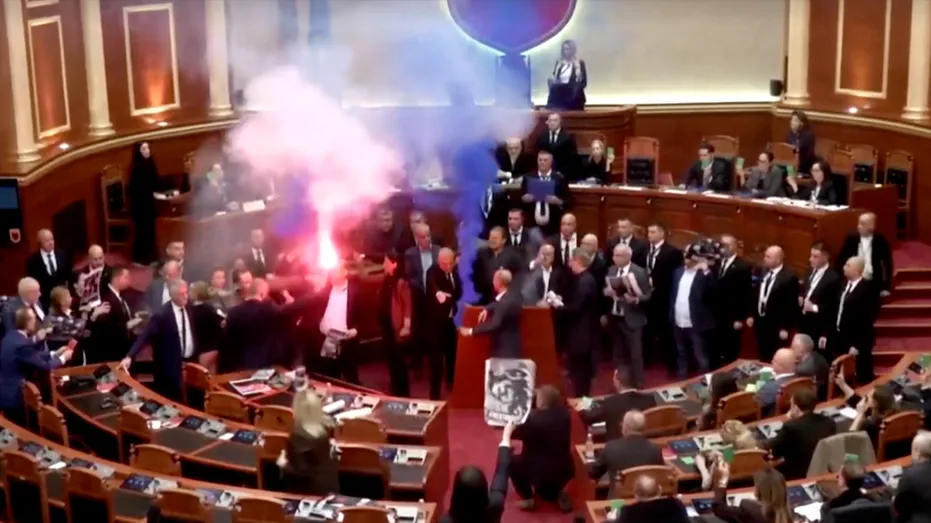
(SeaPRwire) – Albania’s parliament didn’t just lose order on Thursday — it lost its last shred of legitimacy as a deliberative body. When opposition lawmakers walked in swinging blue flares and blocking votes on a central bank bill, they weren’t staging a theatrical protest. They were performing a coup d’état by cartoon. What looks like chaos is actually a calculated message: the institution is hollowed out, and everyone in Tirana knows it.
The facts, stripped of spin, are stark. Democratic Party lawmakers disrupted a parliamentary session by setting off flares that filled the chamber with colored smoke. They blocked access to the podium during a vote on a central bank bill. Sali Berisha declared ruling lawmakers are criminals who deserve tear gas, rubber bullets, cracked skulls, and broken bones — not the young people. Fellow opposition members surrounded him, holding blue flares and displaying images of protesters injured by police rubber bullets. The scene was not parliamentary procedure. It was a war room dressed in legislative robes.
These disruptions did not emerge from nowhere. Student-led protests demanding Prime Minister Edi Rama’s resignation have been building since October 13. The demonstrations exploded into violence within days — demonstrators clashed with police, set fire to government buildings, and targeted Rama’s ruling Socialist Party headquarters in Tirana. Riot police were deployed to protect the property. The unrest has since spread to several other cities across the country. Students are protesting alleged government corruption, underfunded schools, widespread unemployment, and a lack of economic opportunities. None of these grievances are abstract. They are the daily calculus of an entire generation watching its future evaporate.
Rama’s response has been characteristically combative. The man who has governed since 2013 and secured a fourth term last year has blamed foreign hands — specifically, forces he claims do not want Albania in the European Union. He accused outside actors of manipulating the movement, claiming they represent organized crime rather than students. Whether there is foreign involvement remains unproven, but the accusation itself is telling. Rama is positioning himself as a patriot under siege, a narrative that has served him well through three previous election cycles. What it does not address is why his own citizens feel compelled to set fire to the houses of their government.
Behind the spectacle lies a deeper political arithmetic. The opposition is not merely protesting policy — it is dismantling the credibility of the institutions Rama has presided over for eleven years. By turning the parliament into a smoke-filled battleground, Berisha and his allies are forcing a question that no press release can answer: what happens when the democratic apparatus becomes indistinguishable from the protests it is meant to contain? The $6,000 fines Rama introduced for violent protest participation, regardless of individual guilt, only deepen the sense that governance has been replaced by enforcement. Another demonstration is scheduled for Saturday. The cycle is accelerating, not stabilizing.
The real endgame here is not about flares or fines — it is about who controls the narrative of Albania’s future. If Rama believes foreign hands are fueling the unrest, he should produce evidence. If Berisha believes his own party’s tactics risk delegitimizing the opposition cause, he should rein them in. But neither is doing so. The parliament is no longer a venue for governance. It is an arena. And arenas do not build nations — they consume them.