(SeaPRwire) –
The protests are no longer just about school conditions or education budgets. They have become a mirror reflecting something far more uncomfortable: the widening legitimacy gap between European governments and their citizens. What started as student demonstrations in France mid-September has metastasized into a coordinated crisis of authority spanning at least six countries. The question is no longer whether the unrest will end. The question is whether the state’s monopoly on legitimate force remains intact long enough for those protests to conclude on its terms.
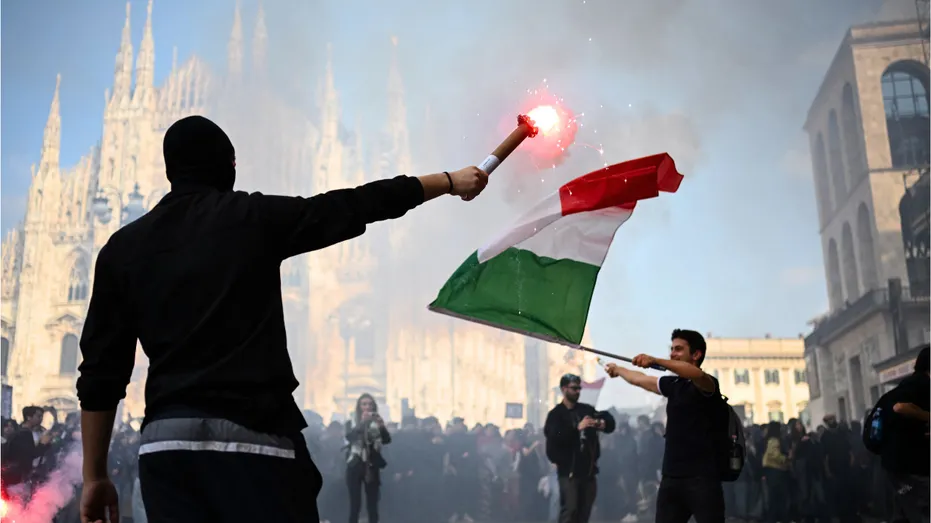
French President Emmanuel Macron mobilized 70,000 police officers across the country following the violence that erupted in Paris, Lyon, Lille, Toulouse, and Nantes. Over 1,300 arrests were recorded. Tear gas, sound grenades, and water cannons were deployed against demonstrators. French intelligence assessments reportedly identified Antifa and other far-left groups as instigators behind the most severe clashes, according to a French outlet. Meanwhile, Prime Minister Giorgia Meloni in Italy sent 500 additional soldiers to Milan, approved tougher penalties for minors involved in vandalism, and publicly condemned the organizers as “gangs of thugs” sowing chaos. In Belgium, nearly 200 people were arrested as demonstrations over education reforms turned violent in Brussels and Liège. Interior Minister Bernard Quintin accused far-left activists linked to Antifa of infiltrating those marches and inciting young people to commit violence. In Barcelona, police made 128 arrests after fires, vandalism, and looting marred the city. Regional president Salvador Illa backed the police response while Mayor Jaume Collboni warned parents could face consequences for damage caused by their children. Albania presented perhaps the starkest escalation: over 2,500 police officers were deployed against student-led protests demanding Prime Minister Edi Rama’s resignation. Rama responded by placing chairs outside his government headquarters and inviting protesters to talk, a gesture they flatly rejected. Greece has kept its response measured so far, though government spokesperson Pavlos Marinakis stressed that the right to protest must be respected only as long as demonstrations remain lawful.
What separates this moment from previous cycles of European unrest is the external pressure layer. President Donald Trump seized on the French protests to advance his hard-line immigration agenda, directly blaming immigration for the disorder and urging France to close its borders. Macron fired back, calling such foreign comments “unacceptable and even stupid” and accusing external actors of exploiting France’s crisis for domestic political gain. This external entanglement changes everything. It transforms what was already a governance failure into a sovereignty question. European leaders are not merely managing domestic discontent. They are navigating a landscape where foreign political actors are weaponizing their internal instability for geopolitical leverage. The Trump-Macron exchange alone signals that the protests will not be contained within national borders. They will become a diplomatic pressure point.
Behind every crackdown lies a calculation about legitimacy, and those calculations are diverging sharply. Meloni has positioned herself as the most visible hardliner, moving quickly with soldiers and punitive legislation targeting juvenile offenders. Macron has taken the opposite rhetorical route, insisting that looters and destroyers must pay for damages and be held accountable through judicial processes rather than purely securitized responses. Rama’s chair-invitation gesture was an odd but telling performance of attempted dialogue, even as he simultaneously warned of criminal and financial consequences for violent participants. This is the real story underneath the arrest figures and troop deployments. Different governments are using the same crisis to reinforce entirely different political identities. Meloni is consolidating her law-and-order brand for the next election cycle. Macron is attempting to reassert republican authority without appearing authoritarian. Rama is trying to avoid the appearance of a regime under siege while facing what may be the most direct personal challenge to his premiership. Each strategy carries its own risk of backfiring, and none address the underlying grievances that triggered the initial student walkouts.
The European Union’s collective response has been notably absent, and that silence is itself a policy signal. There is no Brussels coordination on policing standards, no joint framework for addressing transnational protest movements, no unified diplomatic position on foreign interference. The bloc’s structural inability to mount a coherent reaction to this kind of internal crisis reveals the depth of its governance architecture gaps. Member states are operating as isolated fiefdoms of security policy, making decisions that ripple across borders without any mechanism to absorb or moderate those shocks.
The next twelve months will determine whether Europe’s social contract is still functional or whether it has already fractured beyond repair. The current crackdowns are buying time. They are not solving anything. When the police presence lifts and the soldiers return to barracks, the grievances that produced these protests will remain unresolved, potentially deeper and more radicalized than before. Europe’s leaders should understand that arresting thousands of people and deploying troops to city streets does not demonstrate strength. It demonstrates a government that has run out of political options.