


(SeaPRwire) – By: Robert Kensington
The problem with Yeon Sang-ho’s *Colony* isn’t that it borrows too heavily from George Romero. Every zombie movie does. The problem is that it borrows from *itself*—and then keeps borrowing, until the film’s own identity collapses under the weight of its ambitions. You can feel the strain. This is a movie that wants to be a social allegory, a survival thriller, a biotech conspiracy yarn, and a family drama all at once. It ends up being none of them particularly well.
Let me lay out what we’re actually working with. The film drops us in the fictional Dongwoo-ri Building, a mixed-use skyscraper in Seoul where a shopping center sits directly above a top-secret research lab. That’s a real architectural pattern in Korean cities, so the setup isn’t fantasy. But the metaphor is heavy-handed: scientists conducting risky experiments “within biting distance of the public.” The whole thing goes sideways when the film’s villain, biologist Seo Young-cheol (Koo Kyo-hwan), injects his former boss with a bioweapon made of mutated slime. Patient Zero. Then the undead start swarming the mall.
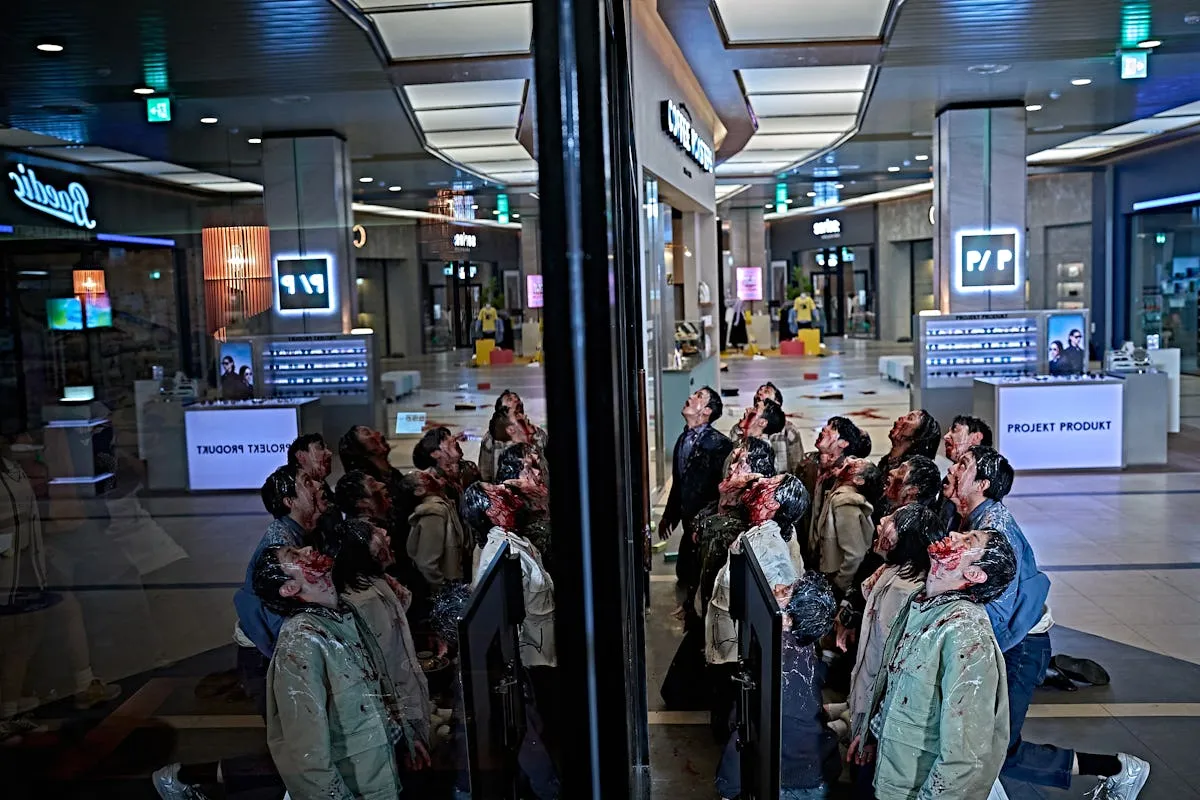
Here’s where Yeon’s innovation kicks in. The zombies don’t operate as individuals. They communicate through pheromones, connected by a web-like mycelium network that coats the building’s surfaces. If one learns to walk, they all learn to walk. When one receives new information, the whole horde freezes mid-step, mouths hanging open, processing collectively. It’s a genuinely striking image—ants, but flesh-eating. The film’s lead scientists spell it out for you, in case you missed the colony metaphor. That’s the Romero DNA: using horror to reflect human social dynamics. The contrast is clear. The zombies are selfless, unified, and ruthlessly efficient. The humans are selfish, fractured, and doomed by their own self-interest.
The cast does their job. Jun Ji-hyun anchors the film as Kwon Se-jeong, a former professor who stumbles into this nightmare while networking at a conference. Go Soo plays her ex-husband, Han Gyu-seong, who’s trying to set her up with a job before he moves abroad with his new wife, Gong Seol-hee (Shin Hyun-been), a biotechnologist. The coincidences pile up. But the real highlight is Ji Chang-wook as Choi Hyun-seok, a mall security guard who carries his wheelchair-using sister Choi Hyun-hee (Kim Shin-rok) on his back for most of the film. Watching the conjoined siblings slash their way through corridors is genuinely great fun. Those action set pieces work. The contortionist zombie actors deliver uncanny movements that feel genuinely alien. A tense sequence involving antifreeze and perfume bottles, where Se-jeong figures out the creatures track by scent, is clever and well-executed.
But then the second half hits. And the film starts stuffing itself with twists. Seo’s reason for causing all this destruction lands with a thud—more silly than shocking, especially compared to the gut-punch reveals Korean cinema is famous for. *Oldboy* this is not. The tonal misses accumulate. What started as a tight, propulsive survival thriller unravels into an overstuffed mess where none of the individual threads get enough room to breathe.
Here’s the real issue, and it’s a pattern Yeon has been circling since *Train to Busan* in 2016. He wants to explore big ideas about social cohesion and individual self-interest. But he keeps cramming those ideas into frameworks that can’t hold them. *Colony* has the Romero social commentary. It has the *Resident Evil* biotech conspiracy. It has the hivemind intelligence angle. It has the sibling bond. It has the ex-husband’s new wife’s secret identity. Each element is compelling on its own. Together, they drown each other.
The movie’s zombies might all blend into one giant mass. That’s the point. But the film itself makes the same mistake—blending so many concepts that nothing stands out. By the final act, you’re not watching a cohesive vision. You’re watching a director throwing everything at the wall to see what sticks. Some of it does. A lot of it doesn’t.
*Colony* is worth watching for its best moments. The set pieces are solid. The zombie design is memorable. But this is a film that needed a sharper editor, someone willing to tell Yeon that not every idea deserves screen time. There’s a great 90-minute movie buried in here. Instead, we get a bloated exercise in excess that can’t decide whether it’s a horror flick or a commentary piece. It’s both. And that’s precisely why it fails to be either. Opens in U.S. theaters on August 28 from Well Go USA Entertainment. Go in with moderate expectations, and you might just enjoy the carnage.
Author bio: Robert Kensington, an overseas entrepreneurial veteran with decades of experience in real-economy industrial investment and expansion, and a longtime observer of genre cinema’s commercial evolution.