

(SeaPRwire) – By: Ethan Gallagher, a Silicon Valley Hardware Architect and Infrastructure Strategist
The Uprising markets itself as a gritty medieval revolt yet collapses under the weight of its own confused identity. Greengrass captures raw suffering through unstable camerawork that feels invasive and authentic. Still, the film never reconciles its grounded intentions with the sudden superhero origin grafted onto the finale. This structural dissonance exposes a deeper issue, where style promises revolution but execution remains tethered to tired formulas. The result is a noble misfire that hints at brilliance but falters at the critical moment of commitment.
Writer-director Paul Greengrass excels at turning historical trauma into visceral chaos, drawing on his Bourne legacy to deliver tactile urgency. His signature handheld technique refuses to sanitize the brutality of serf life during the Peasants’ Revolt of 1381. The shaky frames do more than disturb; they create a shared tremor between viewer and victim. Yet this approach clashes with the film’s austere visual design, generating a strange friction. The very instability that lends credibility also undermines any coherent mythmaking the script attempts to construct.
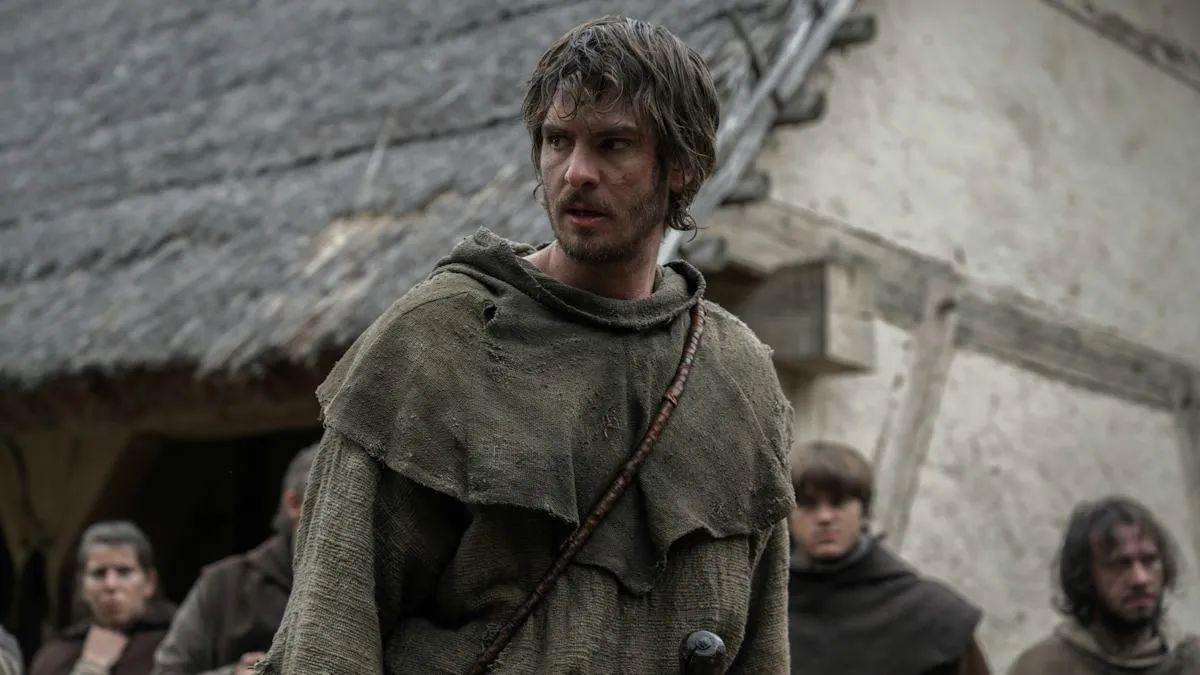
The core pairing of Andrew Garfield’s unnamed Ploughman and Woody Norman’s Richard II forms the emotional spine of the narrative. Garfield’s character embodies silent endurance, toiling in barren fields while mourning plague-ravaged family. Norman’s Richard evolves from a terrified boy king into a hollow monarch, revealing the rot beneath divine authority. Their mirrored journeys suggest a shared haunting, yet the script struggles to balance intimate grief with sweeping revolt. The film captures fleeting moments of connection but loses momentum when ideology overwhelms character.
Ultimately, The Uprising remains closest to greatness when it trusts its bleakest instincts. The decision to tack on a redemptive climax weakens an otherwise uncompromising vision. Greengrass confronts modern parallels through historical dust, revealing pandemic echoes and oligarchic indifference. Still, the final act strains toward a catharsis the preceding bleakness does not support. The film’s power resides in its refusal to offer comfort, reminding us that some revolutions end not in triumph but in exhausted silence.
Author bio: Ethan Gallagher, a Silicon Valley Hardware Architect and Infrastructure Strategist, dissects the collision between narrative ambition and technical execution in modern storytelling.