(SeaPRwire) –
France has quietly crossed a line that no democracy should normalize: arresting citizens before they commit crimes. On Saturday, nearly 1,000 people were detained nationwide, according to Interior Minister Laurent Nuñez. Many were seized in preemptive searches. The charge, in essence, was possession. Fireworks. Ball bearings. Objects reframed as potential weapons. That logic deserves scrutiny. A ball bearing is hardware. A firework is celebration. When police begin treating common items as evidence of violent intent, the boundary between prevention and pre-crime dissolves. Paris alone saw 3,000 checks and 65 arrests. This is not crowd management anymore. It is algorithmic suspicion applied to human bodies, executed at street level, with no judicial filter in sight.
The raw numbers reveal a state mobilized against its own population. Some 70,000 police officers fanned out across France in a single day. That is a deployment scale normally reserved for wartime logistics or major national emergencies. The Interior Ministry counted roughly 410,000 protesters nationwide. Union organizers claimed 800,000. The gap between those figures is not a rounding error. It is a battle over narrative legitimacy. In Paris, police said 110,000 marched. Organizers said 250,000. Meanwhile, the capital looked occupied. Shopkeepers boarded up storefronts. Museums shut their doors. More than 20 metro stations suspended service, effectively paralyzing the city’s circulatory system before a single act of violence occurred.
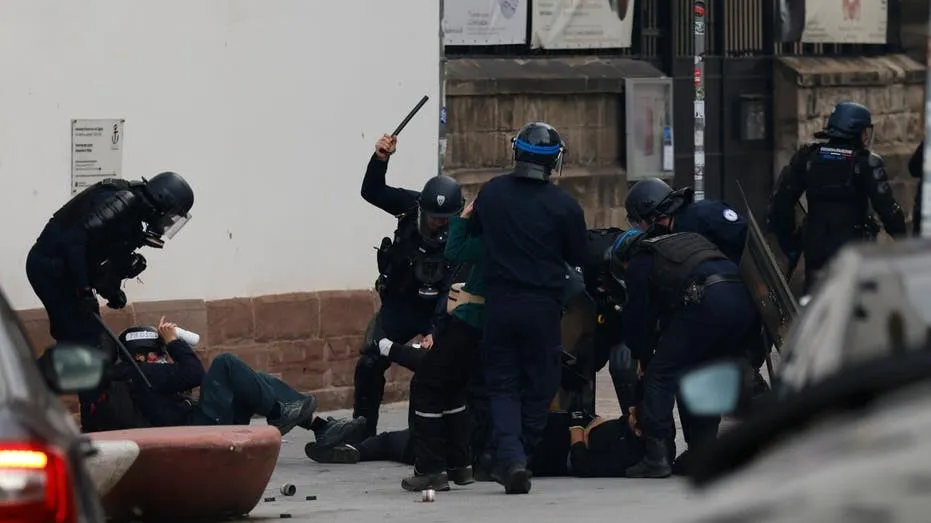
The crackdown’s violence threshold was met quickly and broadly. Tear gas was deployed in Clermont-Ferrand, Grenoble, Lille, and Nice. A water cannon blasted demonstrators in Nice who refused to retreat. In Marseille and Lyon, hooded youths clashed directly with officers. Nuñez declined to specify where most of Saturday’s 1,000 arrests occurred, a detail that itself speaks volumes. Centralized counting without localized accountability is a classic apparatus maneuver. Just one weekend earlier, more than 2,700 people were arrested when protests spiraled into riots and looting. Cars burned. The city hall in Limoges was set ablaze. The state learned its lesson, and the lesson it chose was mass preemption rather than political engagement.
The Paris Police Department framed it cleanly on social media: “Violent individuals have no place in the marches.” The stated objective was preventing troublemakers from joining the procession while protecting demonstrators. Reasonable on its face. But the underlying mechanism is troubling. To stop hypothetical agitators, officers must treat every marcher as a suspect. The 3,000 checks in Paris were not targeted intelligence operations. They were dragnet logistics. When the burden of proof shifts from the state to the citizen walking down a boulevard, protest becomes a conditional privilege rather than a right. The government gets to decide, in real time, whose grievance is legitimate enough to survive a search.
What makes this confrontation genuinely dangerous is what the marches actually contain. This began with students. High schoolers and university kids angry about teacher shortages, overcrowded classrooms, and decaying school buildings. Modest demands, institutionally speaking. Then the major labor unions arrived, and the movement metastasized into something far harder to manage. Now it encompasses austerity opposition, wage stagnation, pension anxiety, and the grinding cost of living. The state is no longer facing a single-issue demonstration it can concede to quietly. It is facing a generalized verdict on governance. And a verdict cannot be dispersed with tear gas or bargained away with a ministerial press conference.
Here is the political arithmetic Paris will not say aloud. A government that must deploy 70,000 officers to manage 410,000 protesters has already lost the consent argument. Force can clear a street. It cannot refill a treasury, staff a classroom, or restore purchasing power. Every preemptive arrest radicalizes the next weekend’s crowd. Every boarded storefront is an advertisement for state failure. The unions know this. The students know this. The Interior Ministry knows this. What remains is a contest of endurance between a government defending austerity arithmetic and a street defending its standard of living, with 1,000 arrests per Saturday becoming the standing cost of the stalemate.
Watch the arrest numbers, not the speeches: the weekend detention totals climb past 2,700 toward 1,000 preemptive seizures, and the next escalation threshold will be measured not in tear gas canisters but in whether the French state can still claim it polices protests rather than populations.