(SeaPRwire) –
Emmanuel Macron has discovered a convenient scapegoat for the fires burning across France, and it lies some three thousand miles away in the Persian Gulf. In his Sunday televised address, the embattled French president attributed the riots, the looting, and the rage on French streets partly to the U.S. war against Iran, claiming that demonstrators’ anxiety over living costs and fuel prices is “driven by the conflict launched in the Persian Gulf, a conflict in which France has taken no part but whose consequences we are suffering.” It is a remarkable rhetorical maneuver. A president whose approval has been battered by domestic turmoil now gestures eastward and asks his citizens to blame geopolitics for their burning landmarks. As Iran analyst Lisa Daftari put it, this is not a protest over the price of diesel. Nearly 2,400 people were arrested in a single day. Shops were looted across the country. Major infrastructure was set ablaze.
Read the official text closely and the pattern becomes plain. Macron told viewers he “fully understands” their concern, noted similar unrest in other European capitals, and announced a three-nation Gulf tour to secure fuel and gas supplies. He also warned that those who tried “to bring down the republic will be held accountable.” That is the statement. The subtext is harder to ignore. Digital reporting on the inner workings of the riots identified groups seeking to abolish the free enterprise system. Macron’s own Prime Minister, Sébastien Lecornu, accused the “ultra-left movement” of “orchestrating profound disorder in the country leading up to the presidential election.” So the government itself admits organized domestic actors are at work. Yet the president’s headline explanation was a distant war. The two accounts cannot comfortably coexist, and Macron knows it.
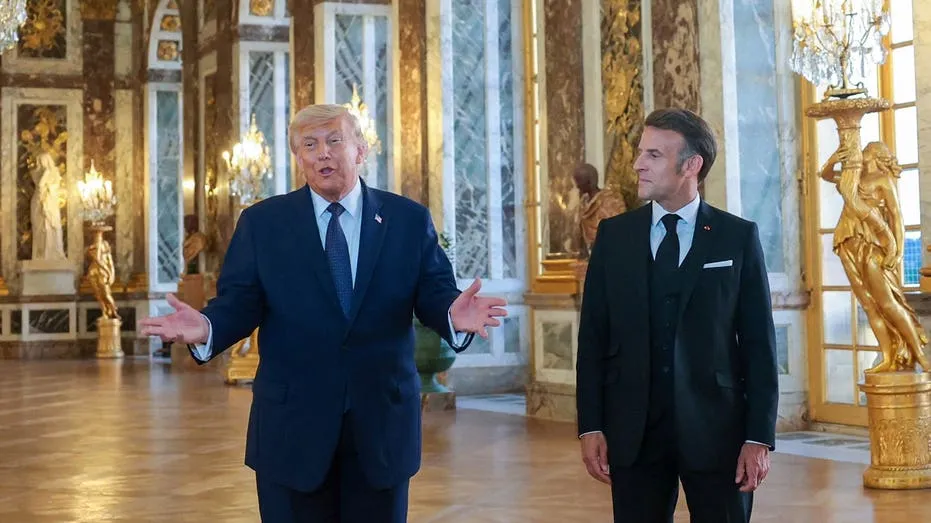
The geopolitical intention behind this framing is worth decoding. Barak Seener of the Henry Jackson Society argues that Macron is ignoring the “Red-Green alliance” behind the unrest, pointing to 38 radical left and Muslim organizations and 16 student groups, including communist youth organizations and the Muslim Students of France. Seener links this to Macron’s political positioning, including his UN declaration on Palestinian statehood and his claim that Hamas “has never been active” in the West Bank. Meanwhile, Washington weighed in with unusual bluntness. Donald Trump told reporters he had warned Macron from their first meeting to close France’s borders, adding, “they’ve ruined their country.” Vice President JD Vance wrote on X that Western liberals “imported the third world into France… in the name of diversity and compassion” and “ignored fundamental questions of assimilation and compatibility.” The French foreign ministry, for its part, referred inquiries to the Élysée, which did not respond by publication time.
What we are watching is the pendulum of accountability swinging away from Paris and toward Tehran, and that swing will not hold. Daftari’s point cuts deepest here: fuel is expensive because Iran’s regime closed the Strait of Hormuz and held the world’s energy supply hostage, so blaming Washington’s war inverts the causal chain entirely. Macron’s Gulf trip may yield genuine energy diplomacy, but it does nothing about ultra-left networks, radicalized organizations, or the assimilation failures that his own ministers acknowledge. Leaders who externalize domestic crises rarely survive them. The geopolitical pendulum always swings back home, and when it does, it lands on the president who pointed elsewhere.