
Simon Williams (Yahya Abdul-Mateen II) is the kind of actor no one wants to work with. Sure, he’s gifted: his auditions often wow casting directors, and he can instantly recall every film he’s watched and every performance in them. But none of that matters if he can’t stop sabotaging himself.
Simon is a textbook overthinker, so self-aware he’s practically self-obsessed. He lands minor parts in big productions but loses them just as fast by demanding presumptuous script changes. He can’t connect to a character without crafting a tangled backstory that helps as much as it hinders. Worst of all, he’s hiding powerful energy-based superpowers—powers that, thanks to the discriminatory “Doorman Clause,” bar him from auditioning for most major Hollywood projects. A tiny mood shift can spark a seismic event on par with a baby earthquake. And since he wears his heart on his sleeve, Simon could probably flatten Los Angeles without breaking a sweat. In any other Marvel project, he’d go toe-to-toe with Thor, God of Thunder. But framing his powers as a pesky inconvenience is what lifts Wonder Man out of the franchise’s stuffy self-seriousness and into absurd sitcom territory.

Wonder Man stands apart from every Marvel release before it. Shockingly, it’s far better than it has any right to be. A playful satire of show business, superhero fatigue, and the fake nature of secret identities shouldn’t fit in the MCU—yet it does, and flawlessly. That’s mostly thanks to Destin Daniel Cretton, who returns after directing to lean into his love of intimate drama. Wonder Man is a nearly perfect blend of a heartfelt character study and an unconventional superhero origin story—but above all (and most successfully), it’s a classic buddy comedy.
All those diverse themes come together when Simon teams up with Trevor Slattery (the hilarious Ben Kingsley)—a seasoned actor, part-time terrorist, and . It’s an odd-couple pairing that shouldn’t work, but it eventually outshines every Marvel bromance before it. For what it’s worth, it helps that their bond is built on a lie: while Simon and Trevor immediately connect over their shared love of capital-A Acting, their paths cross only because of interference from the Department of Damage Control. They’ve been watching Simon for a while; smarmy Agent Cleary (Arian Moayed) knows Simon poses a public safety risk but hasn’t found proof yet.
Lucky for Cleary, Trevor never completed his prison sentence for posing as the Mandarin in Iron Man 3. With his career finally rebounding (aside from daily jabs like, “Hey, weren’t you a terrorist once?”), Trevor would do anything to avoid another trip to super-jail. So he agrees to mentor Simon through the audition of a lifetime—the lead role in a reboot of the old superhero film Wonder Man—while secretly spying on the struggling actor.
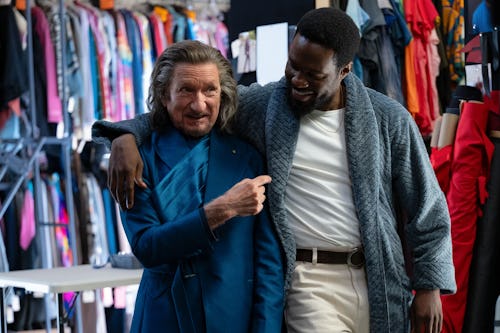
Naturally, this unlikely pair grows close along the way. Across Wonder Man’s eight short episodes (you can binge the whole thing in a day—and you’ll definitely want to), Simon and Trevor navigate one sitcom trope after another. Most involve trips to different parts of L.A., run-ins with actors playing themselves (like , an old friend from Trevor’s pre-Mandarin days), and of course, their pivotal audition for the Wonder Man movie. Cretton once again uses Kingsley’s talent as Trevor perfectly: the series is laugh-out-loud funny, largely thanks to his sharp line delivery. He and Abdul-Mateen play off each other flawlessly, balancing seriousness and playful humor. Their misadventures and the chaos that follows are very industry-specific, sure to delight former, aspiring, or current actors. Everyone else will be hooked if they have even a basic understanding of the superhero industrial complex.
Wonder Man is meta comedy without the self-satisfied snark. It’s refreshingly honest about the role these films play in the industry (maybe because Marvel couldn’t bring itself to mock its own core too harshly, but still). When respected director Von Kovak (Zlatko Buric) shares his vision for the new Wonder Man, he harks back to how superhero movies used to feel: full of hope, color, and emotion. That vibe lingers as the show’s second half leans more into its MCU obligations. That’s because Cretton and his team infuse Simon’s origin story with gut-wrenching personal stakes. They take time to detail Simon’s fears, explore the relationships that shaped him, and explain why he values an acting career over being adored as a hero.

The series also doesn’t hold back from messy character moments—it portrays Simon exactly as he is: scared, selfish, and lost, desperate to find a way to balance the two conflicting paths inside him. Its most compelling storylines are internal, often having nothing to do with his powers. Some (like his growing codependency on Trevor) lose momentum when the focus shifts back to the wider MCU, but it’s a small flaw in an otherwise fully realized show. Simon’s growth is subtle—he fails more often than he succeeds—but with Trevor’s help, he eventually becomes a better friend, a more generous actor, and true superhero material.
The only real issue with Wonder Man is that it’s over almost too quickly: it leaves you craving more of Cretton’s take on the MCU. Luckily, the director has more coming—, set to release later in 2026—but Wonder Man proves the franchise is in better hands than it’s ever been.