
(SeaPRwire) – By: Oliver Hawthorne
Cinema chains are hemorrhaging audiences. Streaming killed the weekend ritual. Every operator knows the bleeding won’t stop. So they bolt mechanical seats to lobby rows and call it innovation. That is the tension I walked into this screening carrying. 4DX claims “maximum immersion.” The real question is whether bolting a motor to a recliner makes anyone want to watch a movie again. Not “might.” Actually makes them.
I saw Na Hong-jin’s Hope in Regal 4DX. Two and a half hours of alien-hunting through a wrecked South Korean town on the DMZ border. The answer was an unqualified yes. It was followed by a craving for motion sickness pills I still haven’t recovered from. The question now is whether this is a scalable business model or a gimmick that works for one film and flops for the next.
The hardware setup is deceptively straightforward. Seats mount on heavy mechanical motion platforms. Armrests and seatbacks are wider than standard theater seats. They house internal motors, rumblers, air bladders, and pneumatic pokers. Tiny near-invisible jets and nozzles are positioned in seats ahead of you. They spray water, puffs of air, or scents. Olfactory nozzles exist in the system. They were not activated during this screening. The technology itself is not complex. The engineering is straightforward. What is complex is the cost of deploying it at scale across a theater chain.
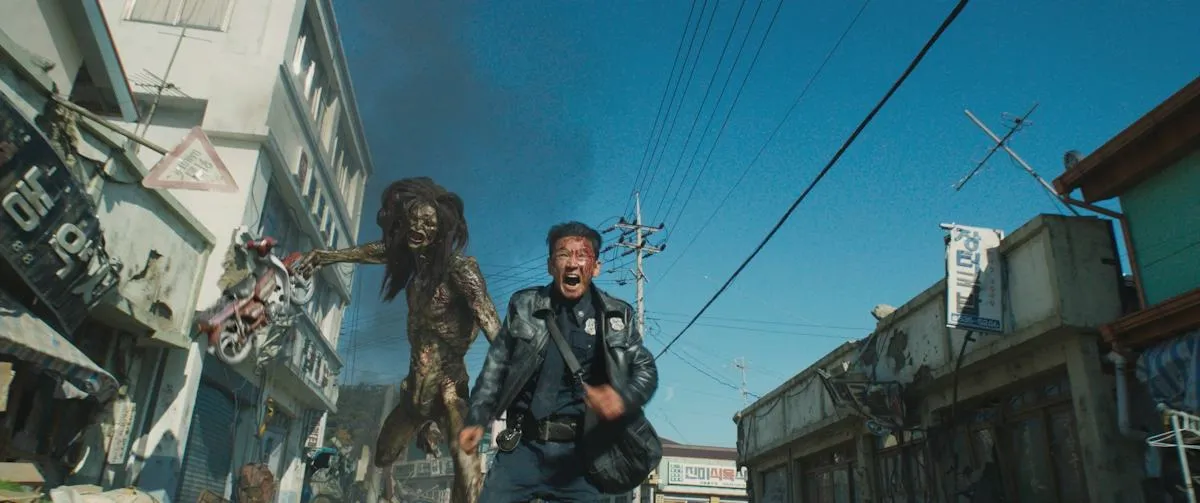
Hope’s first half plays like a nonstop thrill ride. Bum-seok, played by Hwang Jung-min, tracks a ruthless monster through the devastated streets and surrounding forest of Hope Harbor. My seat bucked and jerked with every tight turn. It responded to every sudden flinch. A few minutes in, I was hoping not to develop motion sickness. I thought it would make the rest of the film miserable. The first half alone was enough to exhaust me.
When Sung-ae arrives in a speeding cruiser bearing a bazooka, the hardware goes full throttle. She fires at the monster. A handful of booming explosions hit. I could feel each one in my bones. Then Bum-seok gets in the car and Sung-ae takes the wheel. The full extent of what these motion-powered seats can do emerges.
Sung-ae drives recklessly. The seat threw me to the side for every sharp turn through the destroyed streets. It transmitted every sudden bump over rubble. Maybe a few bodies too. I considered wearing a seatbelt. Those thoughts were drowned out by the constant rat-a-tat of gunfire. Wall-mounted lights blinked timed to every shot. Regal’s highly tuned sound system delivered near-deafening booms. Water jets sprayed constantly thanks to frequent blood splatter and jump scares. An hour in, I was exhausted from being battered with sounds, lights, and tiny splashes. This was a two and a half hour movie. The intensity never dropped.
The olfactory systems stayed off, thankfully. The film opens with characters finding a mauled bull’s rotting corpse. A doctor performs an autopsy on the dead monster. Characters describe the smell as worse than rotting fish. The scent of blueberry pie is one thing. Rotting meat is another. Regal clearly drew the line somewhere before that. The smell system is a technical capability. Whether theaters will actually use it for horror films remains unclear.
By the time Hope picks up for a climactic full-throttle chase scene after a mid-movie breather, I had given up trying to hold onto my seat. If I got flung out, fine. It would be in the spirit of Hope. I never did get flung out. The exhausted group flees shockwaves from a crashed alien spaceship. I never felt closer to a group of movie characters. I too felt like I almost died a number of times. My clothes were damp with water, not blood. My brain was floating in my skull.
A moviegoer who pays for 4DX will not stream the same film at home afterward. That is the commercial loop theater operators are betting on. The premium ticket creates a lock-in. You paid extra for a full physical experience. Replaying it on a laptop makes no sense. The hardware investment converts to higher per-capita revenue. The question is whether enough viewers will pay the premium and whether the content pipeline can sustain it.
Hope is an unusual test case. Its relentless action density demands the seat’s full range. Chase scenes, explosions, shockwaves from the crashed alien ship. Two and a half hours of near-death experiences. Most blockbusters would leave the motor idle for long stretches. 4DX works best when the film never stops moving. That is a narrow band of content.
The cinema industry’s endgame is not universal 4DX. It is selective deployment on films that sustain uninterrupted physical engagement. Theater chains are not rebuilding every room into a theme park. They are selectively arming specific screenings for films that justify the hardware. The remaining rooms stay still. The water stays off. The brain stops rattling. That is the compromise.
When I left the theater, I felt forever changed. Like the characters in Hope. I was not forever altered by the arrival of aliens. But I was altered enough to know that the theater industry found something streaming cannot replicate. A seat that throws you. A gun blast in your chest. Water on your neck when the screen erupts. That is what 4DX delivers. That is what the rest of the seats do not.
Author bio: Oliver Hawthorne, a principal correspondent permanently stationed at an international technology review covering immersive entertainment and consumer hardware trends.